Showing posts with label WW11. Show all posts

Sunday, 3 May 2015

Doug Gregory DFC R.I.P.

Sad news today to read that Doug Gregory DFC has died. He was knocked down by a car whilst walking to collect his newspaper and died in hospital two weeks later. Here is the Telegraph obituary;

Doug Gregory - Pilot obituary


 Doug Gregory DFC

Doug Gregory served as a pilot during World War 2 on 141 Squadron at the same time as my Grandfather, Howard Kelsey. He later wrote a book called Aeroaddict (here's a link) which I am using to fill in some of the colour and flavour of their time on the squadron. My Grandfather was very tight-lipped about his wartime experience, so I am having to use other sources to try and find out more about what RAF life was like back then.

Here's a clip of Doug talking about flying Beaufighters; Doug Gregory and the Bristol Beaufighter

As a mark of respect I thought I would post a scan of one of Doug Gregory's combat reports. By this time he was flying DeHavilland Mosquitoes. One night in July 1944, along with his navigator Steve Stephens, he shot down a JU88 over Beauvais, France.


On August 5th that year he was awarded the DFC. It is typical of Doug that the comment beside the log-book entry mentioning the award of his DFC reads “I still don't know why”.

So another night fighter pilot is added to the 'celestial score' but I hope his memory will live on.


Sunday, 19 April 2015

Flying Instructor Training


On 23rd May 1941 my Grandfather bid farewell to P/O Stearn and 22 E.F.T.S and moved on to train as a Flying Instructor at 4 S.F.I.S ((Supplementary) Flying Instructors School) at R.A.F. Cambridge. 

The Log Book shows that on 26th May, he had a flight in a Miles Magister L.8176 under the instruction of P/O Tompkins. This is the first new aircraft type my Grandfather flew in. Miles Magister - Flight tests

Affectionately known as the "Maggie" this open cockpit monoplane had a much better viewing position for the pilot plus the introduction of flaps, brakes and a tail wheel for the trainee pilot to contend with. It also had it's own flying idiosyncrasies, too much pressure on the rudder bar and the aircraft would pitch abruptly earthwards!


Here's a clip of a "Maggie" in flight

For the remainder of May and June 1941 my Grandfather went through a rigorous set of flying tests to assess his abilities.


Finally, on the 25th June 1941, following the "C.O's Test" with S/Ldr A.D. Bennett he qualified as an Elementary Flying Instructor.


At the same time, Operation Barbarossa, the invasion of Russia by the German forces, had commenced. This was the largest military operation in World history, and would be both the salvation of the Western allies and the ultimate downfall of Hitler and the Nazis.


Monday, 6 April 2015

Sequence of Instruction


Throughout April and into May 1941, my Grandfather continued training in D.H. 82 Tiger Moths, with endless circuits and 'bumps' (landing and take off), as well as a bewildering series of numbered activities. By now, these numbers were so mundane that my Grandfather no longer bothered to fill in what the numbers referred to in the "Duty" column. So following some investigation, I have found out the following 'Sequence of Instruction';

1. Air experience 
1A. Familiarity with cockpit layout 
2. Effect of controls 
3. Taxying 
4. Straight and level flying 
5. Climbing, gliding and stalling (includes stall off steep turn. High speed stall) 
6. Medium turns 
7. Taking off into wind 
8. Powered approach and landing 
9. Gliding approach and landing 
10. Spinning (with instructor only) 
11. First solo 
12. Sideslipping 
13. Precautionary landing 
14. Low flying (with instructor only) 
15. Steep turns 
16. Climbing turns 
17. Forced landings 
18. Action in event of fire (with instructor only) (including abandoning an aircraft to be given on the ground) 
19. Instrument flying 
20. Taking off and landing out of wind 
21. Aerobatics 
22. Air navigation 
23. Air navigation test 
24. Night flying (record number of landings) 
25. Formation flying

I guess that the more often repeated activities were the ones that had not quite been mastered satisfactorily. 

One of the strangest things to happen in the War occurred in May 1941. While the Luftwaffe was making one last effort to bomb London into submission, a lone Me 110 was flying to Scotland. The pilot baled out and upon being apprehended, announced himself as Rudolf Hess, Hitler's deputy in the Nazi Party. There is more about this on the World War 2 Today Website .


Wednesday, 25 February 2015

Taking Off into Wind

Well I suppose I'd better get back to my Grandfather's Pilot's Flying Log Book and also back to the War.

Training to fly in a D. H. 82 with P/O R.T.Dew instructing, March 1941

What was it like to learn to fly in a De Havilland 82 Tiger Moth? Well I'm afraid that I shall have to refer to other sources for this information because by the time I was born, my Grandfather had completely turned his back on his days in the RAF. Luckily for me though, another pilot who flew in the same squadron at the same time as my Grandfather has written a self-published book about his recollections.

Doug Gregory DFC was a pilot in 141 Squadron and his book Aeroaddict is well worth a read. He displays some of the same "have-a-go", yet self effacing attitude that my Grandfather had. This an excerpt from his book about his training in Tiger Moths;

 "Up until now my instructions from the front seat were "Keep your feet on the floor and keep your hands to yourself until I tell you differently." Into wind we turned, off down the field we ran, into the air we climbed. My idea of bliss. Not for long. The voice from the front said, "Now, place your feet on the rudder pedals and now hold the stick with your right hand. Let the aeroplane fly straight and level." The aeroplane flew itself. Even after this first air experience exercise, the Tiger made a better job of flying itself than with my interference. This was going to be easy."

I'm sure it was harder than he describes. Doug Gregory went on to become a test pilot so he was obviously a man of natural flying gifts.

My Grandfather was also having to spend afternoons at 6EFTS in the classroom, learning the theory of his 'trade'. So much to learn and do, and yet the war still raged on all fronts. 


31 Mar 1941 - The German Afrika Korps start an offensive to recapture Tobruk. Because of the need for aircraft on other campaigns (particularly in Greece), only three squadrons of Hurricanes and one of Blenheims remained in defence of the port. Within two weeks, the port was surrounded and Axis forces had crossed the Egyptian border.

Friday, 13 February 2015

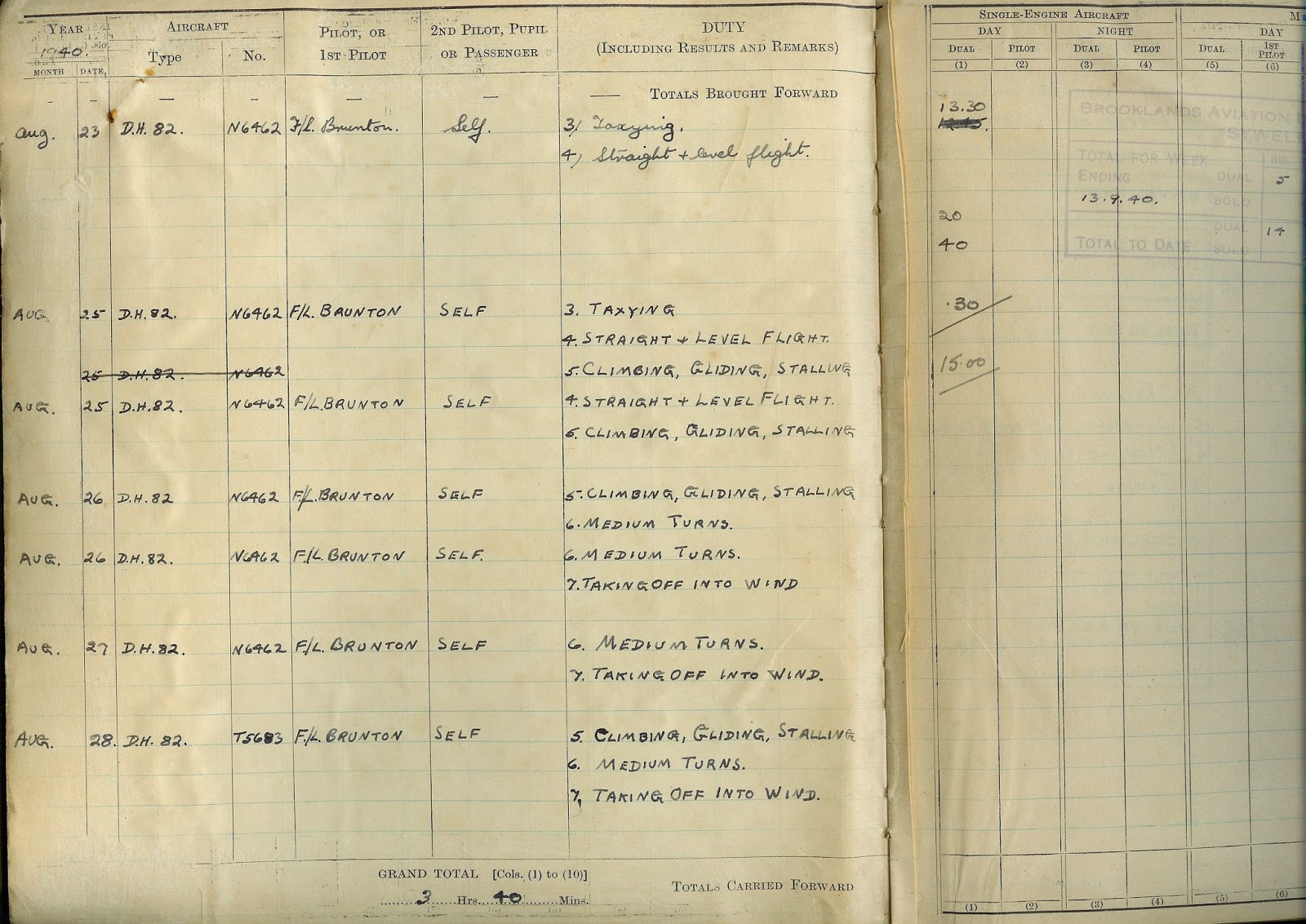
Straight & Level Flight

1st page of H.C. Kelsey's RAF Log Book

The first page of my Grandfather's RAF Pilot's Flying Log Book shows him going up in a D.H.82 (De Havilland Tiger Moth) N642 with F/L Brunton as the trainer in August 1940. It's incredible to think that pilots were still training in bi-planes, but it must have also been very exhilarating, yet frightening to be flying in an open cockpit.


D.H.82 Type used by 6EFTS Sywell in 1940

Here's an early film giving an instruction on how to fly a Tiger Moth

August 1940 was a pivotal month for the RAF as outlined on the RAF website history timeline

24/25 Aug 1940 - German bombs fall on central London for the first time. The following night, 43 aircraft from Bomber Command retaliate by bombing Berlin.

So Leading Aircraftsman H.C.Kelsey knew that the war was hotting up and he had better get trained and operational as soon as possible.

Thursday, 12 February 2015

Taxying


So here is my Grandfather's RAF Pilot's Flying Log Book. This is the first of three and has details of all the flights he took in the first part of his RAF career, starting in Aug.1940 and ending in Feb.1944.

He had volunteered to fight for a cause he saw as just, namely the end of Fascism, and he was excited to be part of the fight. However, learning how to fly was not going to be easy and he would have to learn a lot of other information on engines, airframes, bombing, gunnery, armament, signals, navigation, airmanship and much more besides. And learn it quickly! But just for the moment his life was all mapped out and the exciting days were ahead.


Leading Aircraftman Kelsey 2nd from left.


Thursday, 5 February 2015

"What did you do in the War Grandad?"

Fighting Fascism, not for the King.

Wing Commander Howard Charles Kelsey DSO DFC & Bar


My Grandfather was an Officer in the R.A.F. during World War 2 and remained in the service until the mid 1960's. He volunteered at the age of nineteen and commanded his first squadron at the age of twenty-three. This may not seem all that remarkable, until I point out how politically motivated he was. He was a very proud Socialist and regarded politics as the most important aspect of his life.

I did not know much about his wartime heroics until I started to do some research after his death. He didn't want to talk about those memories and was always very anti the military and a member of C.N.D! If you asked him about the War, he'd say "Oh, I've got my Log Books somewhere", exchange a sheepish glance with my Grandmother, and very quickly change the subject. So not the usual picture of an Officer in the RAF. I intend to post some extracts from his Log Books and hope to find out more about what he got up to all those years ago.