Showing posts with label 21EFTS. Show all posts

Monday, 14 September 2015

The End of the Beginning - September 1942


Since putting in a request for a transfer to "nightfighters" in June 1942, the wheels at the M.O.D. had been slowly turning and by September 1942, it looks like my Grandfather would be moving to pastures new. From his Log Book, I see that the last day my Grandfather, F/O H.C. Kelsey, served as a Flying Instructor at 21 E.F.T.S., Booker, Marlow, was 11th September 1942. On that day he flew a 'solo' test in a Miles Magister R6445 for thirty minutes, followed by a training flight in a Tiger Moth T7845 with LAC Kidd for an hour and that was that.  

Tiger Moth taxying at Booker

In his final assessment, after a year and three months service, his C.O., S/Ldr A.J."Jackie" Hicks commented that my Grandfather was of "Average" proficiency as a Pilot and "Inclined to over-confidence". I think that we can sense that there may not have been a great deal of love lost between these two men! I'm not sure how seriously these comments would be taken by his future Commanding Officer, but I do know that many fledgling pilot's careers where blighted by comments made in their Log Book.

However, I have read many recollections from RAF pilots of their early days as a flying trainee and nearly all of them echo this sentiment from LAC Stephen Johnson in his book "A Kriegie's Log";

‘Everybody has a tremendous respect for the man who teaches him to fly an aeroplane. You have a lasting sense of gratitude and admiration for your first Flying Instructor. It is unlikely that you will forget entirely your first girlfriend but you don’t remember her with anything like the same affection and respect as you do the man who says, ‘Well off you go,’ on your first solo flight.’

My Grandfather would have been really proud of all the trainees he had helped to "go solo". He would also have enjoyed meeting people from all walks of life, both in the RAF and the Army, as well as volunteers from Commonwealth Countries such as Canada and South Africa. I don't know how many of these men would have survived the war, but of the names on this scan of his Log Book alone I know that F/Lt Appleby was killed in a bombing raid over Berlin in 1944 and Corporals Potts and Saunders flew a glider in the capture of the bridge over the River Orne on D-Day.


But most importantly he had mastered the controls of two different aircraft and amassed 1094.15 valuable flying hours. Through many hours of practise, he was becoming a very good pilot. On his final moments in a Tiger Moth, in full view of the control tower, he would have performed some aerobatics, closed the throttles and glided towards the airfield in text-book manner. By side slipping expertly to reduce speed and judging the effect of the wind to perfection, he would softly land in the first third of the airfield, taxy smartly across to the hangars, switch off, jump out and not look back. A 'Piece of Cake'!


Eric Ravilious 1942


The wider World War held some brighter news for a change for the allies. During the Battle of Alam el Halfa, RAF air superiority helps to hold back Rommel's final attempt to encircle the British 8th Army under the command of Montgomery. In South-East Asia, the Japanese land forces suffer their first defeat at the Battle of Milne Bay, when Australian and U.S. forces combined to push them back, easing the threat to Australia. However, darker news was coming in from Russia with the start of the Battle of Stalingrad, heralding some of the worst hand-to-hand fighting of the war as well as the starvation of many Russian civilians. The RAF was still sending large numbers of bombers over to bomb Germany. On 10th September 1942, they target Dusseldorf, with 360 aircraft dropping 700 tons of incendiaries and using a Pathfinder target marking force. This caused terrible fires and massive damage. Many German civilians were killed and 30 RAF bombers didn't make it back.

Aerial photo over the centre of Dusseldorf Sept. 1942, showing ack-ack tracer and smoke from the fires caused.


Monday, 31 August 2015

"Brylcreem Boys" training the "Brown Jobs" - July 1942


Despite putting in a transfer request to "nightfighters", the summer months of 1942 found my Grandfather, H. C. Kelsey, still training pilots in Tiger Moths and Miles Magisters for 21 E.F.T.S. at Booker, Marlow. However, the eagle eyed amongst you will have seen something interesting in this scan of his Log Book....


In brackets after the name 'Brown' is the word (Cpl). Cpl refers to Corporal and there wasn't and still isn't a rank of Corporal in the RAF. So what's going on?

Well, this is all about a new initiative in warfare for the British army. Following the Germans' airborne attack on Crete with Parachutists and Gliders, Churchill decided to copy the idea and set up a British Army Air Corps. One part of this Army Corps was the Glider pilot regiment, which was inaugurated on 24th February 1942 and made use of the RAF (Brylcreem Boys) to train army recruits (Brown Jobs) to fly. 


So it looks like my Grandfather was caught up in this new idea and for the next few months he put the following army personnel through their paces:-

Cpl Brown    Cpl Flodman    Cpl Percy    Cpl Owen     Cpl Bence  
Cpl Wood     Cpl Prince     Cpl Urquhart Cpl McMillen 2/Lt Cairns
Cpl Potts    Lt Anderson    Cpl May      Cpl Watson   Cpl Bland
Cpl Evans    Cpl Berry      Cpl Tilling  Cpl Binnington 
Cpl Wright   Cpl Travis     Sgt Sinclair Cpl Purcell  Cpl Martin
Cpl Ryans    Cpl Baglin     

Here's a group photo I found on Google of a Glider Pilot force being trained at 21 EFTS in July 1942, but there are no names attached, unfortunately.


Initially, these squaddies were delighted to be part of this new Regiment, with one recruit, Staff Sgt Victor Miller, writing in his book "Nothing is Impossible", that the food was excellent compared to normal army food, time off was given ungrudgingly and most weekends were free. On top of that, being trained at 21 EFTS at Booker was "easygoing and fascinating" as well as being the closest to the London nightspots of all the training aerodromes.

The motto of this Regiment was "Nothing is Impossible", but the trainees that were under my grandfather's tutelage were destined for a very tough war. Of the men in the list above, I have discovered that Lt Cairns was awarded a posthumous VC in the Second Chindit Expedition. Having landed by glider behind the Japanese lines in Burma in 1944, Lt Cairns was involved in a hand-to-hand battle on "Pagoda Hill" when, despite having his arm hacked off by a Japanese officer, he shot his attacker at point blank range, picked up the sword which had severed his arm and leading his men on, proceeded to slash at every Japanese soldier in reach. The other men in the list whom I have found mention of on the internet are Cpl Binnington and Cpl Bland, who took part in Operation Market Garden, the famous 'Bridge Too Far' balls-up at Arnhem in May 1945. The Glider Pilot Regiment suffered 90% casualties at Arnhem, so you can imagine that not many of the trainees my Grandfather dealt with made it through to the end of the war.


All these heroics are in the future, strange to think of 1944/5 as the future, but in Summer 1942 my Grandfather knew nothing of the death and carnage that was about to hit his trainees. Although his life as a pilot trainer was not without hazard. Indeed, casualties at all British RAF airfields during training were running at about 3%, this included both trainees and flying tutors. However, RAF Booker seems to have escaped relatively lightly. That's not to say there were no casualties and it seems that Cpl Brown, who lead me into this story of RAF and Army co-operation, was not to survive his time training at 21 EFTS. On the 4th Sept 1942, whilst "going solo",  Corporal P. E. Brown's Tiger Moth swung on take-off, stalled and spun into the ground, killing the pilot. The date is marked in my Grandfather's Log Book with just a break of two days, by 7th Sept. everyone at the base was back to work as usual. "Keep Calm and Carry On"

1942 was another bad year for the British and her allies. With the retreat in the face of the Japanese and the fall of Singapore, the fall of Sevastopol and the loss of Tobruk, combined with the shortages due to sinking of ships of the Atlantic convoys, the Brits at home would have been forgiven for thinking they may not win this War. In fact, on July 2nd, Churchill faced a vote of "no confidence" in the Commons due to his handling of the War. He only survived this vote by talking up the "steady resistance" of the Russians.

But July 1942 was also an important date for the War, when on the 4th July, United States Army Air Force (USAAF) bomber crews, flying RAF Boston aircraft from RAF Swanton Morley, took part in operations in Europe for the first time attacking enemy airfields in Holland. 


Monday, 24 August 2015

Promotion to Flying Officer 112445 - June 1942

By June 1942, my Grandfather, H. C. Kelsey, had been training pilots at 21 E.F.T.S. R.A.F. Booker for a year and he was starting to get itchy feet. Although he undoubtedly appreciated the regularity of his work and was able to spend his early married life with my Grandmother, not in some distant posting, the war was still not going well for the allies and he wanted to help it to it's conclusion. So he drafted this note to his Commanding Officer, S/Ldr A. J. "Jackie" Hicks, and hoped for the best.


Any request for a transfer usually didn't go down well with a C.O., and this note would have undoubtedly created a stir among the trainers at Booker. But my Grandfather was always one for taking on authority and he wanted to move on.

Speaking of authority, after 16th June 1942 it looks like, from his Log Book, my Grandfather went on leave. Then on 25/6/1942, he was promoted to Flying Officer and given the new service number 112445.


In his later years, he had a very ambivalent relationship to authority, especially the military and the police, but I'm sure as a young man, this promotion would have added an extra swagger to his step!


Newly promoted, becoming very proficient as a pilot, steadily gaining valuable flying hours, happily married and ambitious, my Grandfather's life was on the up. But the war was still not going well for the allies. Despite advances in technology such as the introduction of Gee (navigation), attacks at night by the R.A.F. were still pretty hit or miss affairs. After the first 1,000 bomber raid on Cologne (Bomber Command link)in May 1942, the second 1,000 bomber raid on Essen in June 1942 was seen as a failure as many bombers hit the wrong cities.


One result of these large concentrations of bombers sent in to action was that crew losses began to be represented not as individuals, but as percentages. Anything below 10% losses were deemed "tolerable". The people being bombed were no longer identified as human either, but instead just targets. The dehumanising effect of the use of technology in war was really starting to kick in.


Sunday, 2 August 2015

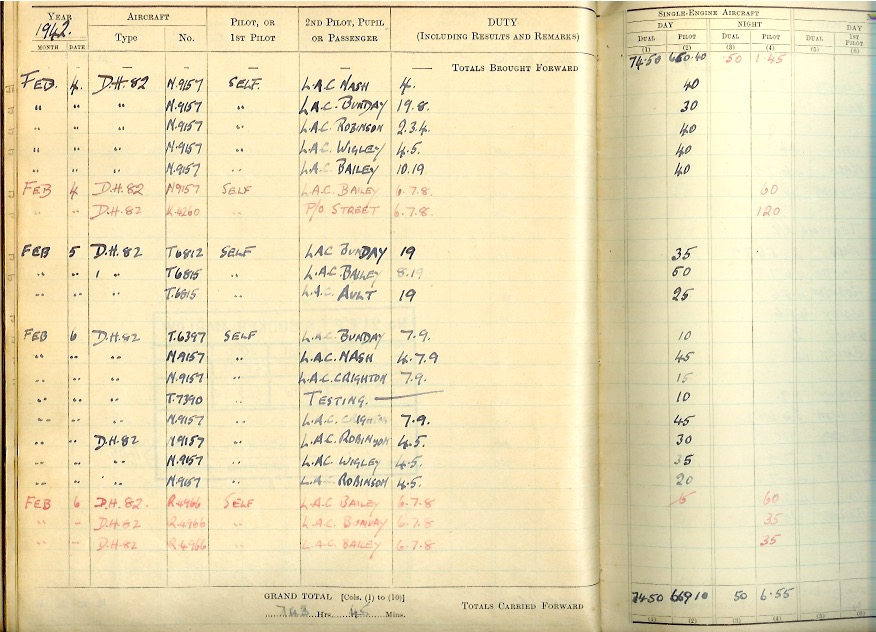
Night-time Circuits and Bumps - February 1942


February 1942 found my Grandfather, Howard Kelsey, taking on a very busy training schedule of both day and night training flights on the same date. Indeed, on the 4th Feb., P/O Street had to endure two hours of "circuits and bumps" with my Grandfather, in the open cockpit of a Tiger Moth, on a freezing February night! I just hope he passed this section of his training.

The day flying hours were indicated in the Log book in black ink and the night hours were in red ink. I'm not sure if this sudden increase in night-flying was due to my Grandfather's future ambitions, or due to the fact that the RAF was undertaking far more night operations at this phase of the war, due to the high levels of daylight casualties among RAF crews. Either way, it must have been incredibly uncomfortable and highly dangerous trying to take off and landing in complete darkness.

I have to thank another RAF pilot, Dudley Steynor, who was also a flying trainer for 21 EFTS at the same time as my Grandfather,  for writing a blog with his reminiscences of his time at RAF Booker. This blog includes some more great stories and also gives further evidence of the high calibre of person that would be influencing the behaviour of my Grandfather who was still a very young, impressionable man. Dudley Steynor was not only an RAF pilot, but also an accomplished pianist. It seems that many of the RAF trainers  had more than one string to their bow. From his blog I learned some more of the daily life of a Pilot trainer at RAF Booker;

"Booker airfield was all grass in those days, and we took off and landed into wind.  We commenced flying at 8.00am and flew until 12.30 or 1.00, had some lunch in the mess and returned to our flying at about 2.00pm.  At 6.00pm we left the flying to the night boys.  Those of us who were flying that night would finish day flying a bit early or might go straight on to night flying and have the following morning off.  A busy life but I loved it.  There were plenty of challenges to be mastered for we flew in all weathers compatible with the aircraft we flew, Tiger Moths and Magisters.  I think most of us became extremely good pilots – as Cecil (Sagittarius Rising) Lewis wrote in his book “All my Yesterdays” ‘There is nothing like instructing for improving one’s flying’."

I also learned from Dudley's blog the rudimentary way that trainee pilots were taught night flying;

"I had many good pupils and rarely failed to get them up to solo flying. I remember one interesting case of a pupil I had to fail on account of his night flying.  The glide indicator at the beginning of the approach used three lights – green, amber or red. If you were too high you saw Amber, if you were too low you saw Red and Green was the correct one.  The Amber meant closing the throttle to lose some height.  The Red meant open the throttle further until you could see Green. This pupil consistently closed the throttle when the red light appeared and I am pretty sure he had no suicide tendencies. He passed all tests for colour blindness. Once when we were three miles away over the valley above Wycombe and the red light showed I had time to ask him ‘What colour do you see?’  He answered ‘Red’.  ‘And what does that mean?’  ‘We are too low’ and he opened the throttle a little which I immediately increase to full throttle and hoped I was not too late!"

I'm not sure what he means by "glide indicator", whether this was a light on the instrument panel, or a light shone from the ground. If you know, I would be interested to hear from you.


From my Grandfather's Log book, during a busy January and February 1942, the following pupils were trained by him in Tiger Moths;

LAC Bunday      LAC Warnes     LAC Walker    LAC Bailey
P/O Arnell      LAC Osborn     LAC Reeve     LAC Waters
LAC Thornton    LAC Warmsley   LAC Dorsie    LAC Bubb
LAC Charman     LAC Crighton   LAC Nash      LAC Robinson
LAC Ault        LAC Wigley     P/O Street    F/Lt Riddell
P/O Barlow      LAC Gray       LAC Geeson    LAC Johnston
LAC McCarthy    F/O Wheatley   P/O Arts.

If you think any of these young men are your relatives, I would be happy to send you a scan of their page from the Log Book.

The war at this time heralded more bad news for Britain with the fall of Singapore to the Japanese resulting in the capture of over 60,000 allied prisoners. We know now how unlikely it was that they would survive the Japanese POW camps. Also the Japanese bombed Darwin, Australia. 


Meanwhile the war in Europe was taking a sinister turn when the "Area Bombing Directive" of 14th February 1942 allowed the RAF to start bombing industrial towns and "dehousing" the German population. In other words, bombing women and children. So much for the moral high ground!

Finally, terrible news was filtering through of atrocities being carried out on Russian prisoners of war by the Wehrmacht, following Operation Barbarossa. Of over 3.6 million Soviet Prisoners of War taken in late 1941 to early 1942, nearly all of them were dead. The attempted annihilation of Bolshevism, and ethnic cleansing of "Asiatics" and "Transcaucasians" by order from Nazi high command meant that prisoners were starved, left out in the snow to freeze to death , or simply shot in huge numbers.

Russian POW's 1941


Sunday, 5 July 2015

Instructor RAF Booker November 1941


In November 1941 my Grandfather, H. C. Kelsey, transferred to RAF Booker, Marlow, Bucks. (RAF Booker Wiki link) He continued training student pilots in Tiger Moths for 21 E.F.T.S. (Elementary Flying Training School), but it seems that someone else started filling in his Log Book as the handwriting is different and the names of his pupils are now included.


Elementary Flying School Tiger Moth


This new posting was interesting because as well as training RAF students, he also started to become involved in the training of Glider Pilot Regiment Pilots. These Glider Pilot students were army personnel and they were being trained in preparation for allied landings in Europe. (Glider Pilot Regiment Wiki link)


RAF Booker Air Training Gliders 

During November and December 1941 my Grandfather trained the following RAF pupils to fly;

L.A.C. Bailey
L.A.C. Barnes
L.A.C. Buxton
L.A.C. Campion
L.A.C. Waldron
L.A.C. Warnes
L.A.C. Bunday
L.A.C. Walker.

Of these pupils, Bailey, Bunday, Walker and Warnes were taken on for further intensive training, which included some night flying.

I don't know anything much about what happened to these men after they gained their wings, but L.A.C. Campion was awarded the George Cross for bravery in helping the crew of a crashed Blenheim. He later died in a Flying Fortress crash in the Azores 1943. ( Michael Patrick Campion GC). If you think you are related to one of these men, I would be happy to send a scan of the Log Book to you.

December 1941 was a pivotal month in the 2nd World War. On the "Home Front", things were getting pretty desperate. With so many men being occupied on war work, the Government decided to implement Women's Conscription (BBC, Women at War). At first, only single women aged 20-30 were called up, but by mid-1943, almost 90 per cent of single women and 80 per cent of married women were employed in essential work for the war effort. 


On the Eastern Front, the Germans abandoned the attack on Moscow, after being bogged down in the snow. Perhaps a history lesson from another little dictator would have shown the folly of not being ready for a Russian Winter! On 6th December, the Russians launched a huge counter attack around Moscow and this was the first major defeat of the Wehrmacht. This news and the fact that on 15 Nov 1941 - The de Havilland Mosquito light bomber enters service with No. 105 Sqn at RAF Swanton Morley, Norfolk, would have been of great interest to my Grandfather!


Then, on 7th December 1941, the Japanese launch an attack on Pearl Harbour, in Hawaii, USA.

USS Arizona after the attack by the Japanese


Sunday, 31 May 2015

Instructor RAF Hatfield 1941


Let us return to my Grandfather's Log Book. After passing out as a flying instructor on 25th June 1941, he is commissioned as a Pilot Officer and posted to 21 EFTS (Elementary Flying Training School) at RAF Hatfield. For the next five months he continues to fly Tiger Moths but just lists "Pupils" in the '2nd Pilot' column. He also continues to accrue more valuable flying time hours.

I must say that I find it amazing that my Grandfather became a flying instructor, because his attempts to instruct anyone in his own family were usually disastrous. Firstly, whilst teaching me how to steer a boat on the Norfolk Broads when I was about 7 years old, his increasingly loud instructions totally confused me and nearly caused us to collide with a rather expensive looking cruiser. Secondly, I think his attempt to help my Grandmother to learn to drive was so bad that she never dared sit in the drivers' seat of a car again for the rest of her life! So I imagine that his wartime flying "pupils" must have had very thick skins...

To my surprise I have found a recollection of one of my Grandfather's pupils on the BBC WW2 People's Story site (here's a link) Arthur Lowndes was training in Tiger Moths in 1941 and his story goes thus;

  "When being trained by Flying Officer Kelsey at Hatfield, he often used to ask pupils to practice a forced landing in a field as if your engine had failed. He did this with me twice, but we found he had an ulterior motive: when we had landed in the field, he jumped out of the Tiger Moth and said `follow me'. I taxied the aircraft round the field to take off again and he would be walking along picking mushrooms. He was very fond of mushrooms and took them back to the mess for his breakfast!!"

This is a lovely story and really shows how my Grandfather loved nature and food! 

As an aside, I also think this posting was lucky, both for him and for the generations of his family that came after him, because it kept him off operations while the RAF improved their aircraft and efficiency. The RAF was, at this time in 1941, the only way we had of hitting back at Germany directly. But the aircraft and technology the RAF used were very primitive. The Blenheims and Stirlings that were used to bomb Germany were very ponderous and trying to navigate and bomb German targets at night was almost impossible. So, many daylight raids were attempted, and the casualty rate was horrendous. On 4th July 1941, a low level daylight raid on Bremen by 15 Blenheims of Nos. 105 and 107 squadrons resulted in a Victoria Cross being awarded to Wing Commander H. I. Edwards. However, four Blenheims and their crews were lost, all the others were damaged and the target was barely scratched. Another mission on the night of 12th/13th October 1941 went badly wrong when 152 aircraft were sent to bomb Nuremberg. Due to weather and navigation error, some crews bombed villages almost 100 miles away from the target. However, on the plus side, a new navigational aid called Gee (wikipedia Gee navigation) was starting to be used and this and other advances in radar would make the RAF start to become more effective as the War progressed.