Showing posts with label Sywell. Show all posts

Saturday, 28 March 2015

Proficiency as Pilot - Average


After a further 20 hours flying training, which included aerobatics, climbing turns, spinning, sideslipping, forced landings, x. country flights, both solo and under instruction, as well as 6 hours 30 minutes instrument flying, L.A.C. Kelsey passed his Elementary flying training on 18/4/1941. He was graded as "Average".

Now came the time for him to be assessed for the next posting in his R.A.F. career. In order to help work out where best to utilise this fledgling pilot, my Grandfather was posted to 22 E.F.T.S Cambridge.


R.A.F. Cambridge was located on the eastern outskirts of the historic University City, next to the village of Teversham. It was approximately 40 miles east of Sywell, and also utilised a large expanse of grass as a landing strip. The training at 22 E.F.T.S. was still in D.H.82 dual control Tiger Moths. These grass landing strips were often the nice soft saviour of many a bumpy landing!


The trainee pilots were billeted in Nissen huts on the northern edge of the airfield, which may explain my Grandfather's love affair with these structures! After retirement, in the 1980's, he spent many laborious hours in his garden in Norfolk turning one of these Nissen huts into a Nuclear Bomb shelter for himself and his nearest and dearest. The wartime billets were heated by one cast iron boiler in the centre and renowned for being freezing in the winter and boiling in the summer. 

After his 47 hours in the air, I wonder if he was a bit put-out to only get a grading of average. If so, he needn't have worried as almost all the other pilots I have read about achieved the same grade.

The news of the war in April 1941 was going from bad to worse for the allies. German forces invaded both Greece and Yugoslavia simultaneously. Yugoslavia capitulated on the 18th April and on 27th German forces entered Athens. 

Wednesday, 4 March 2015

First Solo


So the big moment dawned. This was going to be the test to see if H.C.Kelsey could cut it in the R.A.F. There were usually eighty trainees on the course but only forty would go forward. You were expected to go solo on the Tiger Moth at around 8 hours, certainly not more than 10. Otherwise you would be "scrubbed" and posted to a navigator's course or air gunner or bomb aimer and the likes. One after another, men would come in joyously saying they had gone solo and then there were those with long faces that said one word "scrubbed" and then were gone the next day. 

From his Log Book, it looks as though my Grandfather had hit it right on time at 8hrs 10 minutes for his first 'Solo'. He was taken up for his 'Solo Test' by Sgt. Pawson on 14th March and perhaps Sgt Pawson recommended a bit more practise on 'Gliding Approach and Landing'? Then on 15th March 1941 he was up there alone for the first time, what a feeling that must have been! I can just imagine his beaming face when he landed and ran off to boast to his mates that he had done it..."Gone Solo".


Meanwhile, the War was hitting Scotland, as the 14/15th March saw the "Clydeside Blitz". 

Wednesday, 25 February 2015

Taking Off into Wind

Well I suppose I'd better get back to my Grandfather's Pilot's Flying Log Book and also back to the War.

Training to fly in a D. H. 82 with P/O R.T.Dew instructing, March 1941

What was it like to learn to fly in a De Havilland 82 Tiger Moth? Well I'm afraid that I shall have to refer to other sources for this information because by the time I was born, my Grandfather had completely turned his back on his days in the RAF. Luckily for me though, another pilot who flew in the same squadron at the same time as my Grandfather has written a self-published book about his recollections.

Doug Gregory DFC was a pilot in 141 Squadron and his book Aeroaddict is well worth a read. He displays some of the same "have-a-go", yet self effacing attitude that my Grandfather had. This an excerpt from his book about his training in Tiger Moths;

 "Up until now my instructions from the front seat were "Keep your feet on the floor and keep your hands to yourself until I tell you differently." Into wind we turned, off down the field we ran, into the air we climbed. My idea of bliss. Not for long. The voice from the front said, "Now, place your feet on the rudder pedals and now hold the stick with your right hand. Let the aeroplane fly straight and level." The aeroplane flew itself. Even after this first air experience exercise, the Tiger made a better job of flying itself than with my interference. This was going to be easy."

I'm sure it was harder than he describes. Doug Gregory went on to become a test pilot so he was obviously a man of natural flying gifts.

My Grandfather was also having to spend afternoons at 6EFTS in the classroom, learning the theory of his 'trade'. So much to learn and do, and yet the war still raged on all fronts. 


31 Mar 1941 - The German Afrika Korps start an offensive to recapture Tobruk. Because of the need for aircraft on other campaigns (particularly in Greece), only three squadrons of Hurricanes and one of Blenheims remained in defence of the port. Within two weeks, the port was surrounded and Axis forces had crossed the Egyptian border.

Friday, 13 February 2015

Straight & Level Flight

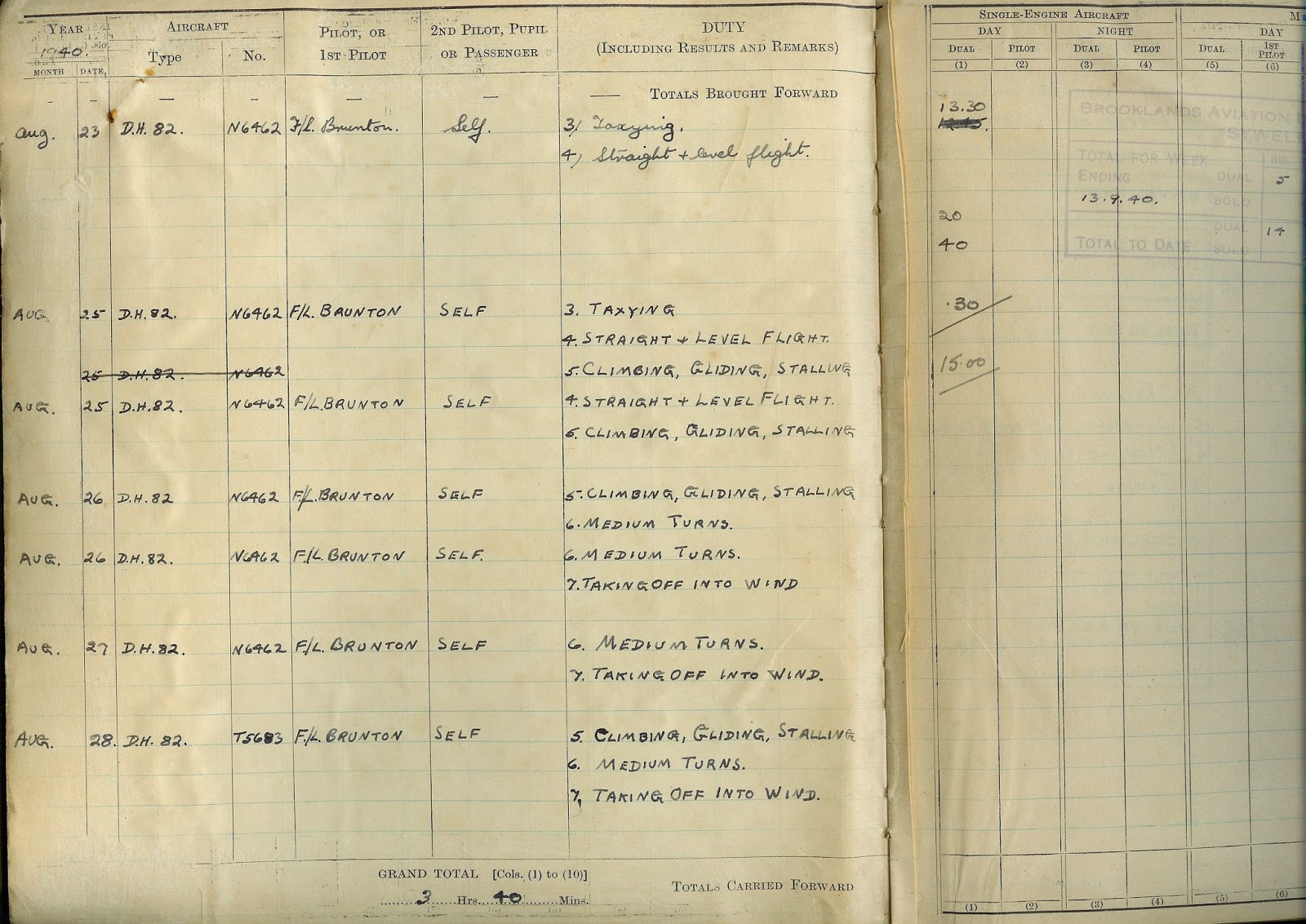
1st page of H.C. Kelsey's RAF Log Book

The first page of my Grandfather's RAF Pilot's Flying Log Book shows him going up in a D.H.82 (De Havilland Tiger Moth) N642 with F/L Brunton as the trainer in August 1940. It's incredible to think that pilots were still training in bi-planes, but it must have also been very exhilarating, yet frightening to be flying in an open cockpit.


D.H.82 Type used by 6EFTS Sywell in 1940

Here's an early film giving an instruction on how to fly a Tiger Moth

August 1940 was a pivotal month for the RAF as outlined on the RAF website history timeline

24/25 Aug 1940 - German bombs fall on central London for the first time. The following night, 43 aircraft from Bomber Command retaliate by bombing Berlin.

So Leading Aircraftsman H.C.Kelsey knew that the war was hotting up and he had better get trained and operational as soon as possible.

Monday, 9 February 2015

Early days

Europe in the 1930s, when my Grandfather was growing up, was a turbulent place. The economic crises of 'the Crash' and 'the Depression' had caused liberal democracies to become undermined and allowed the rise of extremist groups. With the resurgence of Fascism in Germany, Spain and Italy, there came a counter ideology, Socialism, to combat these Dictatorships.

My grandfather, therefore grew up in a hotbed of political struggles and he and many of his school chums at Rutlish Grammar School, were convinced by the arguments of Marxism and Socialism. So much so that a couple of his friends went to fight against Franco in the Spanish Civil War. 

One summer, whilst cycling across Germany with some friends, my Grandfather was thrown out of a cafe and had stones thrown at him for "looking too Jewish". This convinced him that Fascism and intolerance was to be combated and it could only be stopped by War.

By the time War was declared, Richard (Dick), my Grandfather's older brother, was already in the R.A.F. (R. J. Kelsey R.A.F. Officer). I think this spurred him to join up himself, and so his journey began when he volunteered to join the RAF at Bristol in 1940. After Initial Training Wing in Newquay, he was given the service number 1191586 and posted for pilot training on Tiger Moths to No. 6EFTS (Elementary Flying Training School) at Sywell, Northants run by Brooklands Aviation