Showing posts with label RAF. Show all posts

Sunday, 3 May 2015

Doug Gregory DFC R.I.P.

Sad news today to read that Doug Gregory DFC has died. He was knocked down by a car whilst walking to collect his newspaper and died in hospital two weeks later. Here is the Telegraph obituary;

Doug Gregory - Pilot obituary


 Doug Gregory DFC

Doug Gregory served as a pilot during World War 2 on 141 Squadron at the same time as my Grandfather, Howard Kelsey. He later wrote a book called Aeroaddict (here's a link) which I am using to fill in some of the colour and flavour of their time on the squadron. My Grandfather was very tight-lipped about his wartime experience, so I am having to use other sources to try and find out more about what RAF life was like back then.

Here's a clip of Doug talking about flying Beaufighters; Doug Gregory and the Bristol Beaufighter

As a mark of respect I thought I would post a scan of one of Doug Gregory's combat reports. By this time he was flying DeHavilland Mosquitoes. One night in July 1944, along with his navigator Steve Stephens, he shot down a JU88 over Beauvais, France.


On August 5th that year he was awarded the DFC. It is typical of Doug that the comment beside the log-book entry mentioning the award of his DFC reads “I still don't know why”.

So another night fighter pilot is added to the 'celestial score' but I hope his memory will live on.


Thursday, 12 March 2015

'Link' Trainer


For trainee pilots, as well as classroom theory and time in the air, there would be time spent in a machine called a Link Trainer. Designed in the USA in the 1920's by Edwin A. Link, this contraption allowed rudimentary piloting skills to be learned without fear of serious injury. As an introduction to night flying, all took blind-flying instruction in the Link. Movement of the trainer is accomplished by vacuum operated bellows, controlled by valves connected to the control wheel (or stick) and rudder pedals. An instructor sat at the desk and transmitted radio messages which the student in the Link heard through his earphones. Inside the "cockpit", the student relied on his instruments to "fly" the Link through various manoeuvers while his navigational "course" was traced on a map on the desk by the three-wheeled "crab". Slip stream simulators gave the controls the feeling of air passing over control surfaces, and a rough air generator added additional realism during the "flight". 

The 'Link' was the first true flight simulator, and provided safe training to hundreds of thousands of student pilots during the 1930s and 40s.

There were a series of standard exercises to be mastered on the link trainer and it was often housed in it's own purpose built building at many RAF stations.


My Grandfather spent 8 hours and 5 minutes training in the Link and passed with an assessment of 'Average'. I expect he was very pleased to see the back of it! 


Wednesday, 4 March 2015

First Solo


So the big moment dawned. This was going to be the test to see if H.C.Kelsey could cut it in the R.A.F. There were usually eighty trainees on the course but only forty would go forward. You were expected to go solo on the Tiger Moth at around 8 hours, certainly not more than 10. Otherwise you would be "scrubbed" and posted to a navigator's course or air gunner or bomb aimer and the likes. One after another, men would come in joyously saying they had gone solo and then there were those with long faces that said one word "scrubbed" and then were gone the next day. 

From his Log Book, it looks as though my Grandfather had hit it right on time at 8hrs 10 minutes for his first 'Solo'. He was taken up for his 'Solo Test' by Sgt. Pawson on 14th March and perhaps Sgt Pawson recommended a bit more practise on 'Gliding Approach and Landing'? Then on 15th March 1941 he was up there alone for the first time, what a feeling that must have been! I can just imagine his beaming face when he landed and ran off to boast to his mates that he had done it..."Gone Solo".


Meanwhile, the War was hitting Scotland, as the 14/15th March saw the "Clydeside Blitz"

Friday, 13 February 2015

Straight & Level Flight

1st page of H.C. Kelsey's RAF Log Book

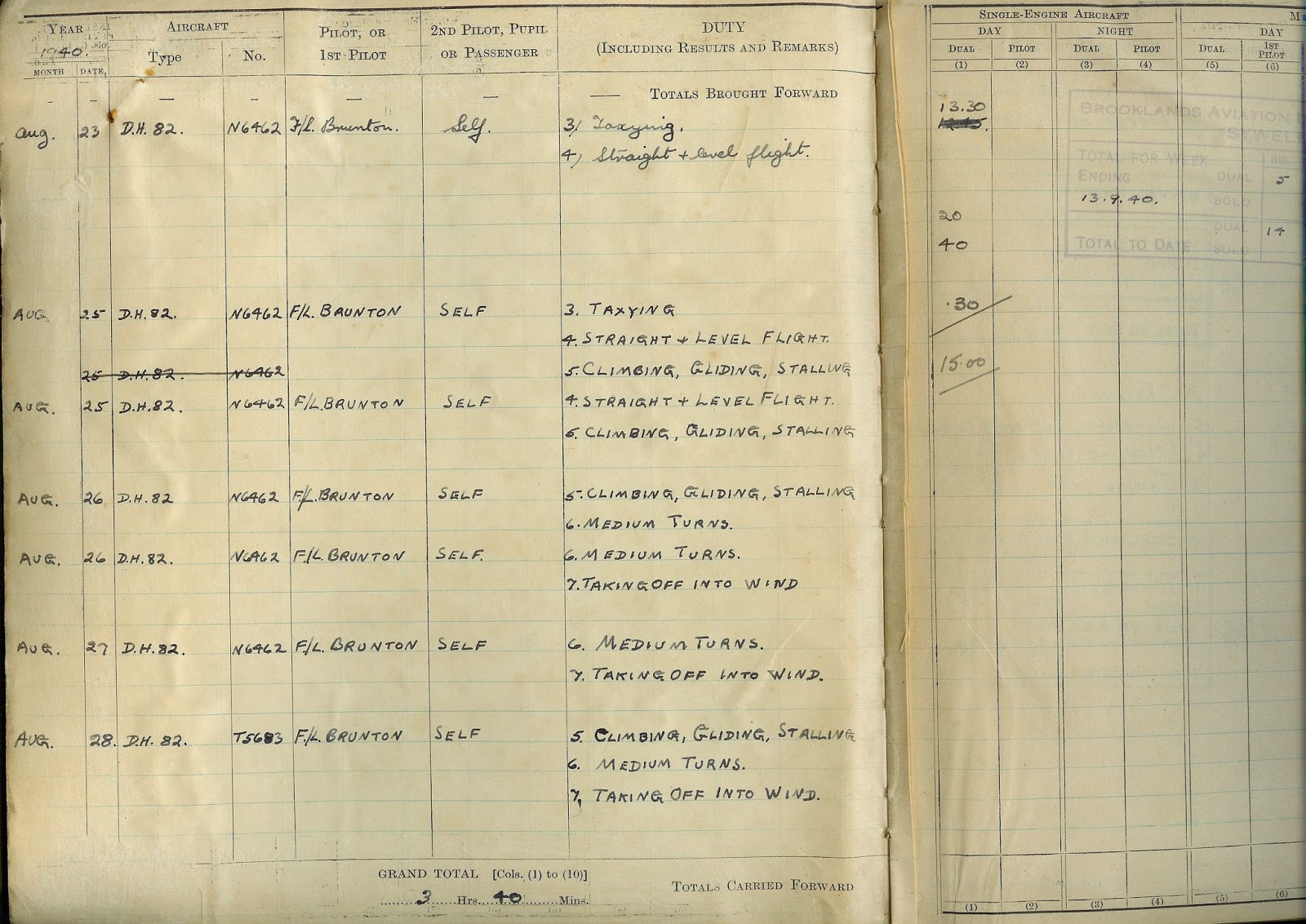
The first page of my Grandfather's RAF Pilot's Flying Log Book shows him going up in a D.H.82 (De Havilland Tiger Moth) N642 with F/L Brunton as the trainer in August 1940. It's incredible to think that pilots were still training in bi-planes, but it must have also been very exhilarating, yet frightening to be flying in an open cockpit.


D.H.82 Type used by 6EFTS Sywell in 1940

Here's an early film giving an instruction on how to fly a Tiger Moth

August 1940 was a pivotal month for the RAF as outlined on the RAF website history timeline

24/25 Aug 1940 - German bombs fall on central London for the first time. The following night, 43 aircraft from Bomber Command retaliate by bombing Berlin.

So Leading Aircraftsman H.C.Kelsey knew that the war was hotting up and he had better get trained and operational as soon as possible.

Thursday, 12 February 2015

Taxying


So here is my Grandfather's RAF Pilot's Flying Log Book. This is the first of three and has details of all the flights he took in the first part of his RAF career, starting in Aug.1940 and ending in Feb.1944.

He had volunteered to fight for a cause he saw as just, namely the end of Fascism, and he was excited to be part of the fight. However, learning how to fly was not going to be easy and he would have to learn a lot of other information on engines, airframes, bombing, gunnery, armament, signals, navigation, airmanship and much more besides. And learn it quickly! But just for the moment his life was all mapped out and the exciting days were ahead.


Leading Aircraftman Kelsey 2nd from left.


Monday, 9 February 2015

Early days

Europe in the 1930s, when my Grandfather was growing up, was a turbulent place. The economic crises of 'the Crash' and 'the Depression' had caused liberal democracies to become undermined and allowed the rise of extremist groups. With the resurgence of Fascism in Germany, Spain and Italy, there came a counter ideology, Socialism, to combat these Dictatorships.

My grandfather, therefore grew up in a hotbed of political struggles and he and many of his school chums at Rutlish Grammar School, were convinced by the arguments of Marxism and Socialism. So much so that a couple of his friends went to fight against Franco in the Spanish Civil War. 

One summer, whilst cycling across Germany with some friends, my Grandfather was thrown out of a cafe and had stones thrown at him for "looking too Jewish". This convinced him that Fascism and intolerance was to be combated and it could only be stopped by War.

By the time War was declared, Richard (Dick), my Grandfather's older brother, was already in the R.A.F. (R. J. Kelsey R.A.F. Officer). I think this spurred him to join up himself, and so his journey began when he volunteered to join the RAF at Bristol in 1940. After Initial Training Wing in Newquay, he was given the service number 1191586 and posted for pilot training on Tiger Moths to No. 6EFTS (Elementary Flying Training School) at Sywell, Northants run by Brooklands Aviation


Thursday, 5 February 2015

"What did you do in the War Grandad?"

Fighting Fascism, not for the King.

Wing Commander Howard Charles Kelsey DSO DFC & Bar


My Grandfather was an Officer in the R.A.F. during World War 2 and remained in the service until the mid 1960's. He volunteered at the age of nineteen and commanded his first squadron at the age of twenty-three. This may not seem all that remarkable, until I point out how politically motivated he was. He was a very proud Socialist and regarded politics as the most important aspect of his life.

I did not know much about his wartime heroics until I started to do some research after his death. He didn't want to talk about those memories and was always very anti the military and a member of C.N.D! If you asked him about the War, he'd say "Oh, I've got my Log Books somewhere", exchange a sheepish glance with my Grandmother, and very quickly change the subject. So not the usual picture of an Officer in the RAF. I intend to post some extracts from his Log Books and hope to find out more about what he got up to all those years ago.