Showing posts with label Log Book. Show all posts

Wednesday, 21 October 2015

Happy 22nd Birthday Grandad - War Still Not Over - October 1942

Pilot's Flying Log Book Oct. 1942
My Grandfather spent his 22nd birthday training at 3(P)AFU RAF South Carney, with two flights in a twin engined airplane called an Airspeed Oxford. His first flight, probably in the morning, was instructed by F/Lt Warren and involved the number 6 cross-country course. There and home the cross-country course took two and a half hours, and with the top speed of an Airspeed Oxford being 192mph, this was approximately a 400 mile round trip.


This course would have relied on the pilot navigating via landmarks, dead reckoning, experience of the area and some luck. All the time the instructor would be noting down your errors and trying to distract you and put you off your calculations. I think the British trainee pilots had an advantage here, compared to the Commonwealth and allied trainee pilots, because they were used to the different and sometimes rapidly changing weather conditions and the more complicated navigational requirements of "patchwork" England.

1942 RAF Map of South Cerney Area

Referring back to Ken Fentons War Blog. that I mentioned in my last blog., Sgt Stephen Johnson gives his recollections of cross-country training.

‘After some time of flying solo we were passed fit to carry a passenger and used to go up with another pupil pilot to do navigation and cross-country flights. I was extremely lucky in being paired off with Arthur Innes who was the only pupil on that course to be assessed as exceptional in the final classification. I was at the same time placed as above average’

‘There was at that time a great shortage of pilots and the courses were being pushed through just as hard as possible. We were sent off on cross-country flights without wireless on some pretty bad days, with visibility only a mile or two and a very low cloud base. On one occasion we never saw the ground at all for about 2 hours. Luckily when we returned on our dead reckoning course we found a gap in the cloud and pinpointed ourselves not very far from where we expected to be.’

‘Being lost while flying an aeroplane is a most unpleasant feeling. When alone you are apt to panic just at the time when it is most essential to remain calm and try to work out where you are. One of the difficulties is that you can’t stop and look at the map. If it takes you about 5 minutes trying to match what you see on the ground with your map you have to remember to look for somewhere else on the map because even at 120 mph you have gone some ten miles. Luckily the South of England was covered with aerodromes where you could land if truly lost. If you did land as a pupil you were not allowed to take off again until your instructor came and fetched you. This wasn’t at all popular. Before the war and again now it is comparatively easy to fly down low and read the names off a railway station but just to be difficult they covered them up during the war and also filled all likely looking large fields with poles which caused little if any disadvantage to the enemy but a great deal of inconvenience to fledgling pilots.’

The second flight my Grandfather took was again with F/Lt Warren and of 1 hour 10 minute duration, involving a couple of exercises and an Instrument Flight(IF).


This would involve pulling a hood over the trainee pilot to obscure any view out of the cockpit and then relying on the instruments to get you back to the airfield. This would be used in conjunction with more training on the link trainer, to simulate night flying with all lamps off.


Airspeed Oxford instrument panel.

Again, I rely on Sgt. Stephen Johnson to let us know what it was like to fly like this,

‘Instrument flying was an important part of our training. We had started on a link trainer at Perth (EFTS) and at Brize Norton we spent a considerable time in one. This was an excellent machine for simulating the conditions of instrument flying and quite invaluable: but it was not the same as actual flight, for there was no feeling of motion to combat. It is a funny thing, flying an aircraft by instruments when you cannot see out at all. You are faced with two alternatives; either you believe what your instruments tell you or you can believe what your own sense of balance and feeling of movement tell you. If you do the later you are killed almost at once. The reason for this is quite simple. If you blindfold someone and put him on a revolving music stool and start revolving him to the right he will say, ‘l am turning to the right’. If after a few moments you stop he will feel that he is turning to the left. In an aircraft if the pilot believes his feelings he will start turning to the right again to counteract it. I believed the instruments. Some people did not.’

I just hope that after this hazardous birthday, my Grandfather treated himself to a pint or two and a singalong with his pals in the local pub.


Sunday, 11 October 2015

Yellow Belly - 3 (P) A.F.U., South Cerney - September 1942

Pilot's Flying Log Book September 1942
After two days leave, on 14th September 1942 my Grandfather, H.C. Kelsey, was posted to No. 3 (Pilot) Advanced Flying Unit (3(P)A.F.U.) at South Cerney, Gloucestershire. This posting would require the mastery of a tricky, twin-engined, aircraft called an Airspeed Oxford. And the new instructor putting him through his "sequence of instruction" paces, as noted in the "Duty" column, was F/Lt. Chance.

Airspeed Oxford with "trainer" paintwork
Furthermore, the posting would mean that he would no longer be an instructor, but instead return to training, in preparation for an operational posting. But did it also mean that my Grandparents would be split up after a year of fairly normal domestic bliss? I can't imagine that Flying Officers were given married quarters during the War. Perhaps my Grandmother had to go back to London and live with her parents? So a lot of changes all at once.

Flying in the Airspeed Oxford, or "Ox-box" as it was fondly known, with it's distinctive yellow-belly trainer markings, was eloquently recounted in his autobiography by F/Lt. Chance, or John Newton Chance as was his full name. He was a novelist who became a flying instructor during the War.


With novelists and pianists as well as poets and artists among the men rubbing shoulders with my Grandfather in the RAF, they must have had a huge influence on this young man's attitude to life. After all, my Grandfather was still only twenty one years old at this time. The War had forced together a very diverse and interesting group of people from all corners of the world and I think this is why that generation seems to have been "special".

So what was it like to fly an Airspeed Oxford? From what I have read, it seems that the first thought many trainee pilots had when first confronted with the large, complicated frightening monster called the Oxford was "I'll never manage THIS!" It certainly was a huge jump from a diminutive Tiger Moth, to the 53 feet 4 inches wingspan of the "Ox-box" with it's two large engines providing 750 horsepower, compared to the Tiger Moth's 130 horses. However, my Grandfather had the advantage of a great deal more flying time than the usual trainee, and knowing him , no doubt he would have been far more excited than frightened. He was a very self-confident man and would probably have started telling the flying instructor how to fly the plane within minutes of starting up!

These recruitment drawings make training in the Airspeed Oxford seem a cozy affair!

In terms of design, the Airspeed Oxford is the first aeroplane that my Grandfather flew which related more to the 2nd World War than to the 1st World War. It had a fully enclosed cockpit for a start, although apparently the glass panes often didn't fit well and a "bracing" breeze could be felt through the gaps! Secondly, the cockpit instruments were arranged well and easily seen, rather than just haphazardly bolted in as an afterthought. However, the "Ox-box" was regarded as tricky to fly well, and deliberately designed so. The theory being that if you could fly the Oxford, then you could fly pretty much any multi-engined aircraft, therefore making it ideal for training. It seems that it was on take-off that the Oxford could have a mind of it's own, as a wartime trainee at 3(P)A.F.U called Stephen Johnson recalls in a blog called Ken Fenton's War;

"After our Tiger Moths, the Oxford seemed a very powerful machine. You had to learn to control the swing on take-off by opening one engine or the other a little more. I had managed to go solo in an Oxford after about two and a half hours dual and felt quite confident about it. We were thrilled by our Oxford’s power when we first started flying them, as they went much faster than Tiger Moths and had all sorts of new gadgets, like retractable wheels which usually went up and down when you pressed a lever and flaps which did likewise."

He continues, 


"There was no electrical intercommunication in Oxfords or Tiger Moths in those days. We used a system akin to those tubes you find in the walls of very old houses. Down these you had to blow at first and this blew a whistle incorporated in a plug at the far end; this in turn summoned a minion from some distant basement. In an Oxford you had a flexible mouthpiece which you tucked into the front of your parachute harness; the other end was plugged into the pupil’s helmet. If you blew into it it made his eardrums pop. This was seldom necessary however as pupils were unlikely to go to sleep while flying.’ 

Another trainee at the time, called Peter Mayhew recounts in this same blog another quirk of the Oxford,

"The Oxford was a good deal more exciting to fly having one or two vices, such as dropping a wing when you stalled it. A week or so after going solo we did our first night flying."

As usual, these men are very understated about the difficulties they experienced in mastering the foibles of the Oxford. In fact stalling an Airspeed Oxford, which, as we know, was part of the training schedule ( See my earlier blog here), was rather hit or miss. Some would stall "straight", whilst others would have a pronounced wing drop, but you would never know for sure which one, so counteracting this before the aircraft started "spinning" required a good deal of pilot skill. Nobody could say flying the Oxford was a "piece of cake", it behaved itself when handled well but tended to bite fools!


Airspeed Oxfords at South Cerney 1942
So with the added difficulties of flying this aircraft, the usual British weather and the relatively busy skies around the airfield, not to mention the fairly frequent raids by the Luftwaffe, the casualties and deaths of young RAF personnel were a serious concern. The average percentage of deaths whilst training was 3%, but this does not include serious, life changing injuries. In the book "Bombing Hitler: One man's war with Bomber Command"T.I. Steel's Grandfather Bernard Steel, was one of the trainers at 3 (P)A.F.U in 1941/2. This passage tells us of his last day at South Cerney;

"As it turned out Bernard's last day at 3 (P) A.F.U. would be 17th October 1942 as he would take a week's well deserved rest before joining his new unit. His final pupil at South Cerney was a Sergeant Heath who, after a fifty minute flight, helped take Bernard's flying time to 832 hours and thirty minutes. Unfortunately October was unable to give the unit a fatal free month. The last man to be killed in a flying accident at 3 (P)A.F.U. while Bernard served there was Sergeant S.F. Smith, who was killed in Oxford AP401 after losing control during a night-time overshoot at Bibury relief landing ground. The aircraft was destroyed by fire after crashing. He was the thirtieth young airman to die at 3 (P) A.F.U. during Bernard's year at South Cerney."

I'm just trying to imagine what it would be like if just one person died where I worked, let alone 30 in one year! And this without getting anywhere near the enemy, just during training. Thirty deaths at just one unit in just one year through occupational accidents... how did they handle this pressure? I know that F/Lt. Chance eventually snapped and had to be invalided out of the service in February 1944.

Airspeed Oxford "Trainer" at Duxford

What of the War in general at this time? Stalingrad is now completely surrounded by the Wehrmacht. Food supplies to the civilians are dwindling and the people are starving to death, with some reports of cannibalism. The fighting is becoming bogged down in house to house attacks, and the casualties on both sides are horrendous. One of the worst battle sites was at Mamayev Kurgan, a strategic high point overlooking the City centre. Originally captured briskly by the Germans on 13th September 1942, the very next day it was the site of a huge Soviet counter-attack from 13th Guards Rifle Division. By September 16th, the Russians had recaptured the hill, but the cost was almost all of the 10,000 Soviet troops who had attacked two days previously. 


BBC The World at War Episode 9 - Stalingrad


Monday, 31 August 2015

"Brylcreem Boys" training the "Brown Jobs" - July 1942


Despite putting in a transfer request to "nightfighters", the summer months of 1942 found my Grandfather, H. C. Kelsey, still training pilots in Tiger Moths and Miles Magisters for 21 E.F.T.S. at Booker, Marlow. However, the eagle eyed amongst you will have seen something interesting in this scan of his Log Book....


In brackets after the name 'Brown' is the word (Cpl). Cpl refers to Corporal and there wasn't and still isn't a rank of Corporal in the RAF. So what's going on?

Well, this is all about a new initiative in warfare for the British army. Following the Germans' airborne attack on Crete with Parachutists and Gliders, Churchill decided to copy the idea and set up a British Army Air Corps. One part of this Army Corps was the Glider pilot regiment, which was inaugurated on 24th February 1942 and made use of the RAF (Brylcreem Boys) to train army recruits (Brown Jobs) to fly. 


So it looks like my Grandfather was caught up in this new idea and for the next few months he put the following army personnel through their paces:-

Cpl Brown    Cpl Flodman    Cpl Percy    Cpl Owen     Cpl Bence  
Cpl Wood     Cpl Prince     Cpl Urquhart Cpl McMillen 2/Lt Cairns
Cpl Potts    Lt Anderson    Cpl May      Cpl Watson   Cpl Bland
Cpl Evans    Cpl Berry      Cpl Tilling  Cpl Binnington 
Cpl Wright   Cpl Travis     Sgt Sinclair Cpl Purcell  Cpl Martin
Cpl Ryans    Cpl Baglin     

Here's a group photo I found on Google of a Glider Pilot force being trained at 21 EFTS in July 1942, but there are no names attached, unfortunately.


Initially, these squaddies were delighted to be part of this new Regiment, with one recruit, Staff Sgt Victor Miller, writing in his book "Nothing is Impossible", that the food was excellent compared to normal army food, time off was given ungrudgingly and most weekends were free. On top of that, being trained at 21 EFTS at Booker was "easygoing and fascinating" as well as being the closest to the London nightspots of all the training aerodromes.

The motto of this Regiment was "Nothing is Impossible", but the trainees that were under my grandfather's tutelage were destined for a very tough war. Of the men in the list above, I have discovered that Lt Cairns was awarded a posthumous VC in the Second Chindit Expedition. Having landed by glider behind the Japanese lines in Burma in 1944, Lt Cairns was involved in a hand-to-hand battle on "Pagoda Hill" when, despite having his arm hacked off by a Japanese officer, he shot his attacker at point blank range, picked up the sword which had severed his arm and leading his men on, proceeded to slash at every Japanese soldier in reach. The other men in the list whom I have found mention of on the internet are Cpl Binnington and Cpl Bland, who took part in Operation Market Garden, the famous 'Bridge Too Far' balls-up at Arnhem in May 1945. The Glider Pilot Regiment suffered 90% casualties at Arnhem, so you can imagine that not many of the trainees my Grandfather dealt with made it through to the end of the war.


All these heroics are in the future, strange to think of 1944/5 as the future, but in Summer 1942 my Grandfather knew nothing of the death and carnage that was about to hit his trainees. Although his life as a pilot trainer was not without hazard. Indeed, casualties at all British RAF airfields during training were running at about 3%, this included both trainees and flying tutors. However, RAF Booker seems to have escaped relatively lightly. That's not to say there were no casualties and it seems that Cpl Brown, who lead me into this story of RAF and Army co-operation, was not to survive his time training at 21 EFTS. On the 4th Sept 1942, whilst "going solo",  Corporal P. E. Brown's Tiger Moth swung on take-off, stalled and spun into the ground, killing the pilot. The date is marked in my Grandfather's Log Book with just a break of two days, by 7th Sept. everyone at the base was back to work as usual. "Keep Calm and Carry On"

1942 was another bad year for the British and her allies. With the retreat in the face of the Japanese and the fall of Singapore, the fall of Sevastopol and the loss of Tobruk, combined with the shortages due to sinking of ships of the Atlantic convoys, the Brits at home would have been forgiven for thinking they may not win this War. In fact, on July 2nd, Churchill faced a vote of "no confidence" in the Commons due to his handling of the War. He only survived this vote by talking up the "steady resistance" of the Russians.

But July 1942 was also an important date for the War, when on the 4th July, United States Army Air Force (USAAF) bomber crews, flying RAF Boston aircraft from RAF Swanton Morley, took part in operations in Europe for the first time attacking enemy airfields in Holland. 


Monday, 24 August 2015

Promotion to Flying Officer 112445 - June 1942

By June 1942, my Grandfather, H. C. Kelsey, had been training pilots at 21 E.F.T.S. R.A.F. Booker for a year and he was starting to get itchy feet. Although he undoubtedly appreciated the regularity of his work and was able to spend his early married life with my Grandmother, not in some distant posting, the war was still not going well for the allies and he wanted to help it to it's conclusion. So he drafted this note to his Commanding Officer, S/Ldr A. J. "Jackie" Hicks, and hoped for the best.


Any request for a transfer usually didn't go down well with a C.O., and this note would have undoubtedly created a stir among the trainers at Booker. But my Grandfather was always one for taking on authority and he wanted to move on.

Speaking of authority, after 16th June 1942 it looks like, from his Log Book, my Grandfather went on leave. Then on 25/6/1942, he was promoted to Flying Officer and given the new service number 112445.


In his later years, he had a very ambivalent relationship to authority, especially the military and the police, but I'm sure as a young man, this promotion would have added an extra swagger to his step!


Newly promoted, becoming very proficient as a pilot, steadily gaining valuable flying hours, happily married and ambitious, my Grandfather's life was on the up. But the war was still not going well for the allies. Despite advances in technology such as the introduction of Gee (navigation), attacks at night by the R.A.F. were still pretty hit or miss affairs. After the first 1,000 bomber raid on Cologne (Bomber Command link)in May 1942, the second 1,000 bomber raid on Essen in June 1942 was seen as a failure as many bombers hit the wrong cities.


One result of these large concentrations of bombers sent in to action was that crew losses began to be represented not as individuals, but as percentages. Anything below 10% losses were deemed "tolerable". The people being bombed were no longer identified as human either, but instead just targets. The dehumanising effect of the use of technology in war was really starting to kick in.


Sunday, 26 July 2015

New Year 1942 - High Flying Brothers.

The year 1942 found my Grandfather, Howard Kelsey, in the relatively peaceful pursuit of training new RAF pilots at Booker airfield, Marlow. Meanwhile the War all around was raging on. The RAF operations in Britain mainly concentrated on attacks on German warships and naval facilities in the Atlantic and North Germany. But with the Japanese sweeping through the Far East, many young RAF pilots lost their lives in the retreat from Malaya and Singapore. I still thank all the Heavens that my Grandfather was still not "On Ops" (flying combat operations) at this stage of the War.

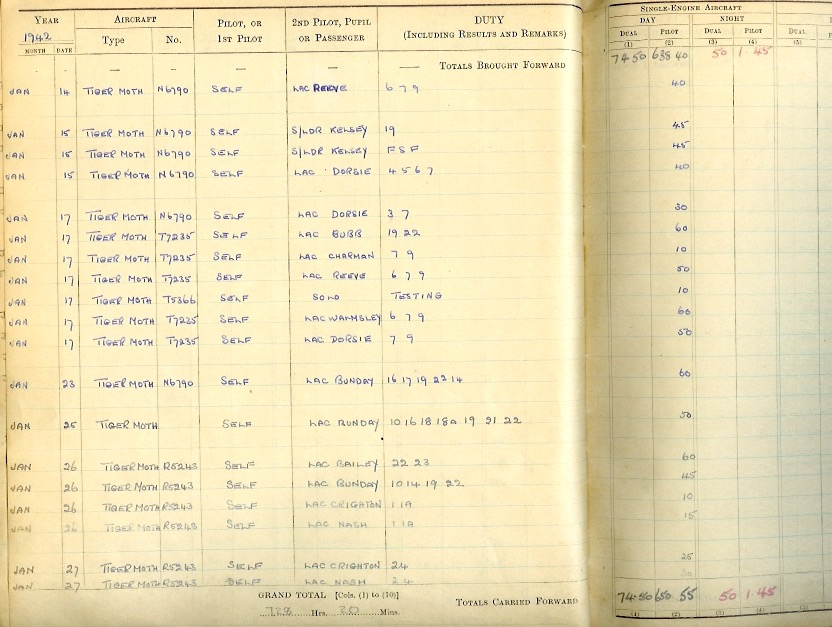
My Grandfather's Log Book for January 1942 shows him continuing to put his pupils through their paces. But there is one interesting  entry on Jan 15th, which shows him piloting a Tiger Moth with his brother S/Ldr Kelsey in the Passenger seat!


S/Ldr Richard J Kelsey, later known to me as Uncle Dick, had been commissioned in the RAF in 1936. He joined 213 (Fighter) Squadron at RAF Northolt in 1937, flying Hawker Hurricanes. 

Hawker Hurricane


In December 1941 he was promoted to Squadron Leader (Temporary) and the following January found himself being bounced around the sky by his baby brother!

The "Duty" column for their first flight together shows the number 19, which when I refer back to my blog "Sequence of Instruction"(Link) means "Instrument Flying". This was to simulate night flying and was accomplished by pulling a canopy over the pupil so they were in the dark and could only fly using their instrument panel. Obviously the trainer could still see and would avert possible crashes if necessary!

Tiger Moth with night flying hood

I really have no idea why my Grandfather was putting his brother through this test, but perhaps Uncle Dick was learning how to do it, so he could train his own squadron? I do know that he became Chief Flying Instructor at No. 2 EFTS.

The second flight they took has "FSF" in the "Duty" column. Having scoured the RAF acronym websites, I cannot find what this means. Perhaps "Fighter Squadron Ferry", or maybe "Flying Simulator Flight"? If anyone knows, I would be very interested to find out the meaning.

S/Ldr R J Kelsey

Uncle Dick had trouble with his eyesight during the War and had to have special corrective goggles made to enable him to continue in the service. He was involved in a Hurricane crash in March 1939 (Link) and there is a sad piece about him from the Daily Express in August 1939 written by Victor Ricketts - Daily Express Air Reporter;

"SOMEWHERE in Westland I stood at sunset with an R.A.F. fighter pilot who four years ago was passing into the sixth form at a public school. Over us circled a flight of three Hurricanes silhouetted blackly, against the sunset. Inside each of the rumbling fighters sat a war-wise youngster ready to slam his throttle wide open in pursuit of raiding bombers. We two stood and looked up at the fighters, that between them carried enough bullets to kill 10,000 men and the young man with silver wings on his chest said quietly, "No! I am not flying tonight. You see I am going blind." 
It was evening, with dew on the airfield grass, camouflaged planes ranged out, a mobile field kitchen with the fragrant smell of hot coffee, and far away, now, the drone of the patrolling fighters. I said, "Oh," rather stupidly. 
"They've just taken me off flying," I heard him say. "Both my eyes are going a bit dim. I'll be able to see a bit I think, but flying's finished for me. "I had a Rugger accident a few years ago, got a kick on the back of the head. That started it I think." 
You hear things, quietly like that, that beat the films. This same boy was until a little while ago a pilot in a crack fighter squadron. It was his life and very nearly his death. Roaring along on night manoeuvres he had the real-life nightmare of all who fly in the dark—instantaneous and complete breakdown of his engine. At five miles a minute his engine started coming to pieces. Beneath were no lights, only darkness hiding trees hedges, walls, rivers; all the necessary-things to break his neck trying-to land three tons of steel at ninety m.p.h. He took the only way out, through the sliding roof of the dropping fighter . . . with a kick to carry himself clear as he fell into space. Then the moment of suspense, wondering if the silken shrouds of the parachute would open. They did, with a jerk that knocked the breath out of his plummeting body. "Don't you believe that stuff about coming down like thistledown," he grinned. "You hit the ground with a wallop." The fighters were out of sight and we went to a hangar to collect my own parachute ready to take off when our-patrol time came."

Later in the war Uncle Dick was posted to Joint Services Staff college in Haifa, after which he became Officer Commanding RAF station Gaza and then to Air Staff at HQ Middle East in Cairo until the end of the War. 

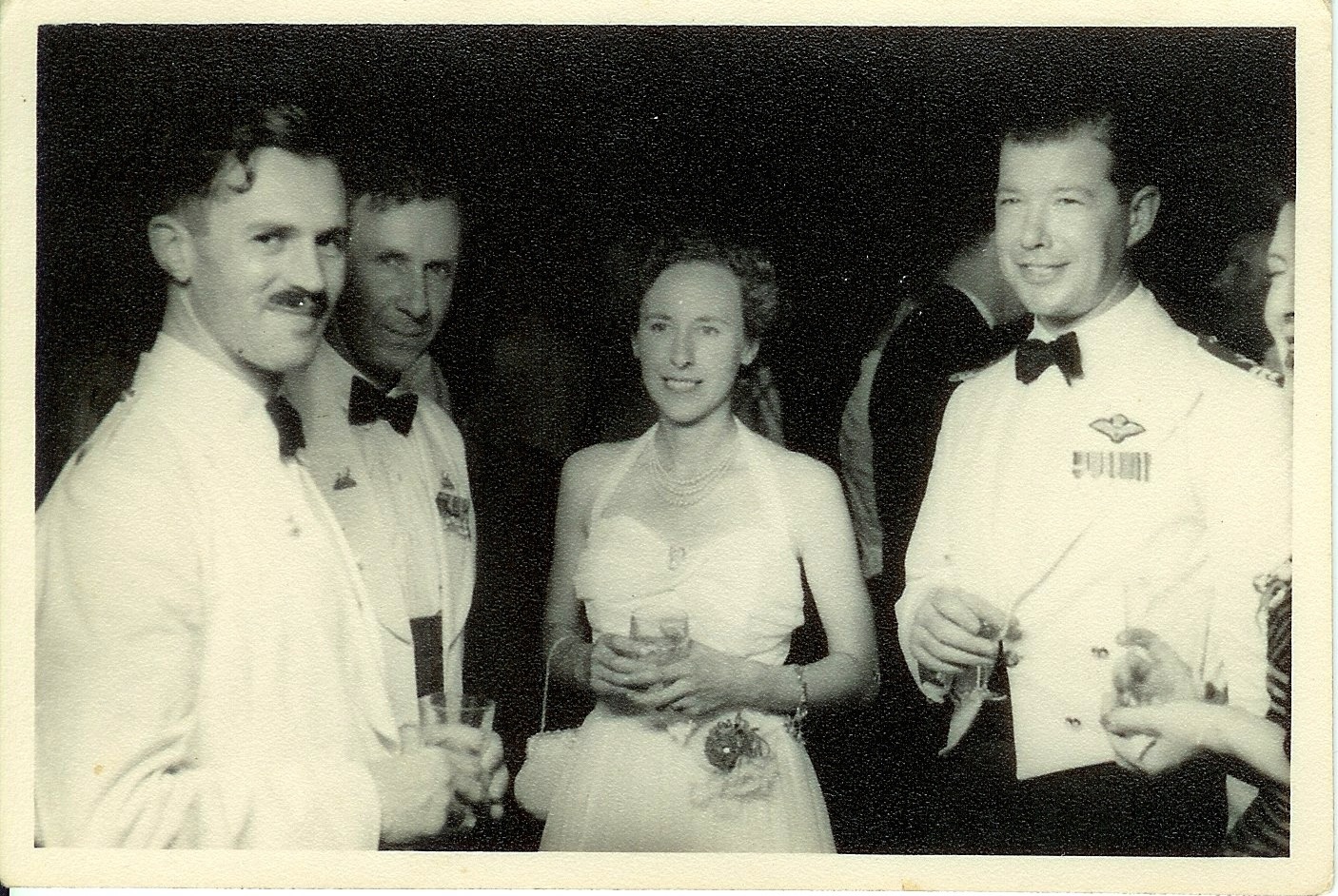
Uncle Dick on the right with his wife, Rose, in the centre.

After the war, Uncle Dick was promoted to Wing Commander and finally retired from the Air Force in 1959. He passed away in February 2010 in Suffolk and I was very pleased to have met up with him again before he died.


Sunday, 31 May 2015

Instructor RAF Hatfield 1941


Let us return to my Grandfather's Log Book. After passing out as a flying instructor on 25th June 1941, he is commissioned as a Pilot Officer and posted to 21 EFTS (Elementary Flying Training School) at RAF Hatfield. For the next five months he continues to fly Tiger Moths but just lists "Pupils" in the '2nd Pilot' column. He also continues to accrue more valuable flying time hours.

I must say that I find it amazing that my Grandfather became a flying instructor, because his attempts to instruct anyone in his own family were usually disastrous. Firstly, whilst teaching me how to steer a boat on the Norfolk Broads when I was about 7 years old, his increasingly loud instructions totally confused me and nearly caused us to collide with a rather expensive looking cruiser. Secondly, I think his attempt to help my Grandmother to learn to drive was so bad that she never dared sit in the drivers' seat of a car again for the rest of her life! So I imagine that his wartime flying "pupils" must have had very thick skins...

To my surprise I have found a recollection of one of my Grandfather's pupils on the BBC WW2 People's Story site (here's a link) Arthur Lowndes was training in Tiger Moths in 1941 and his story goes thus;

  "When being trained by Flying Officer Kelsey at Hatfield, he often used to ask pupils to practice a forced landing in a field as if your engine had failed. He did this with me twice, but we found he had an ulterior motive: when we had landed in the field, he jumped out of the Tiger Moth and said `follow me'. I taxied the aircraft round the field to take off again and he would be walking along picking mushrooms. He was very fond of mushrooms and took them back to the mess for his breakfast!!"

This is a lovely story and really shows how my Grandfather loved nature and food! 

As an aside, I also think this posting was lucky, both for him and for the generations of his family that came after him, because it kept him off operations while the RAF improved their aircraft and efficiency. The RAF was, at this time in 1941, the only way we had of hitting back at Germany directly. But the aircraft and technology the RAF used were very primitive. The Blenheims and Stirlings that were used to bomb Germany were very ponderous and trying to navigate and bomb German targets at night was almost impossible. So, many daylight raids were attempted, and the casualty rate was horrendous. On 4th July 1941, a low level daylight raid on Bremen by 15 Blenheims of Nos. 105 and 107 squadrons resulted in a Victoria Cross being awarded to Wing Commander H. I. Edwards. However, four Blenheims and their crews were lost, all the others were damaged and the target was barely scratched. Another mission on the night of 12th/13th October 1941 went badly wrong when 152 aircraft were sent to bomb Nuremberg. Due to weather and navigation error, some crews bombed villages almost 100 miles away from the target. However, on the plus side, a new navigational aid called Gee (wikipedia Gee navigation) was starting to be used and this and other advances in radar would make the RAF start to become more effective as the War progressed.

Sunday, 19 April 2015

Flying Instructor Training


On 23rd May 1941 my Grandfather bid farewell to P/O Stearn and 22 E.F.T.S and moved on to train as a Flying Instructor at 4 S.F.I.S ((Supplementary) Flying Instructors School) at R.A.F. Cambridge. 

The Log Book shows that on 26th May, he had a flight in a Miles Magister L.8176 under the instruction of P/O Tompkins. This is the first new aircraft type my Grandfather flew in. Miles Magister - Flight tests

Affectionately known as the "Maggie" this open cockpit monoplane had a much better viewing position for the pilot plus the introduction of flaps, brakes and a tail wheel for the trainee pilot to contend with. It also had it's own flying idiosyncrasies, too much pressure on the rudder bar and the aircraft would pitch abruptly earthwards!


Here's a clip of a "Maggie" in flight

For the remainder of May and June 1941 my Grandfather went through a rigorous set of flying tests to assess his abilities.


Finally, on the 25th June 1941, following the "C.O's Test" with S/Ldr A.D. Bennett he qualified as an Elementary Flying Instructor.


At the same time, Operation Barbarossa, the invasion of Russia by the German forces, had commenced. This was the largest military operation in World history, and would be both the salvation of the Western allies and the ultimate downfall of Hitler and the Nazis.


Monday, 6 April 2015

Sequence of Instruction


Throughout April and into May 1941, my Grandfather continued training in D.H. 82 Tiger Moths, with endless circuits and 'bumps' (landing and take off), as well as a bewildering series of numbered activities. By now, these numbers were so mundane that my Grandfather no longer bothered to fill in what the numbers referred to in the "Duty" column. So following some investigation, I have found out the following 'Sequence of Instruction';

1. Air experience 
1A. Familiarity with cockpit layout 
2. Effect of controls 
3. Taxying 
4. Straight and level flying 
5. Climbing, gliding and stalling (includes stall off steep turn. High speed stall) 
6. Medium turns 
7. Taking off into wind 
8. Powered approach and landing 
9. Gliding approach and landing 
10. Spinning (with instructor only) 
11. First solo 
12. Sideslipping 
13. Precautionary landing 
14. Low flying (with instructor only) 
15. Steep turns 
16. Climbing turns 
17. Forced landings 
18. Action in event of fire (with instructor only) (including abandoning an aircraft to be given on the ground) 
19. Instrument flying 
20. Taking off and landing out of wind 
21. Aerobatics 
22. Air navigation 
23. Air navigation test 
24. Night flying (record number of landings) 
25. Formation flying

I guess that the more often repeated activities were the ones that had not quite been mastered satisfactorily. 

One of the strangest things to happen in the War occurred in May 1941. While the Luftwaffe was making one last effort to bomb London into submission, a lone Me 110 was flying to Scotland. The pilot baled out and upon being apprehended, announced himself as Rudolf Hess, Hitler's deputy in the Nazi Party. There is more about this on the World War 2 Today Website .


Wednesday, 4 March 2015

First Solo


So the big moment dawned. This was going to be the test to see if H.C.Kelsey could cut it in the R.A.F. There were usually eighty trainees on the course but only forty would go forward. You were expected to go solo on the Tiger Moth at around 8 hours, certainly not more than 10. Otherwise you would be "scrubbed" and posted to a navigator's course or air gunner or bomb aimer and the likes. One after another, men would come in joyously saying they had gone solo and then there were those with long faces that said one word "scrubbed" and then were gone the next day. 

From his Log Book, it looks as though my Grandfather had hit it right on time at 8hrs 10 minutes for his first 'Solo'. He was taken up for his 'Solo Test' by Sgt. Pawson on 14th March and perhaps Sgt Pawson recommended a bit more practise on 'Gliding Approach and Landing'? Then on 15th March 1941 he was up there alone for the first time, what a feeling that must have been! I can just imagine his beaming face when he landed and ran off to boast to his mates that he had done it..."Gone Solo".


Meanwhile, the War was hitting Scotland, as the 14/15th March saw the "Clydeside Blitz"

Friday, 13 February 2015

Straight & Level Flight

1st page of H.C. Kelsey's RAF Log Book

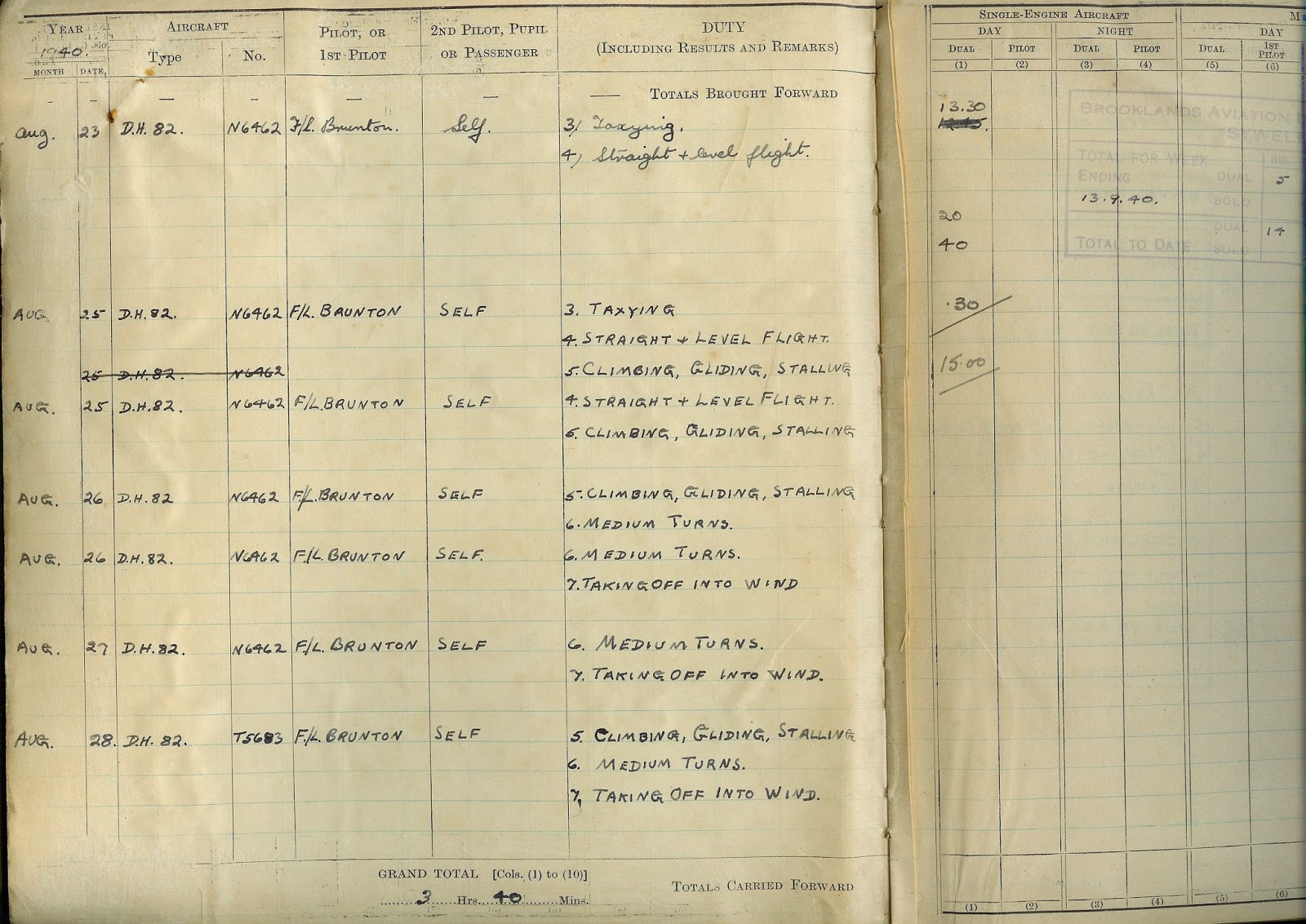
The first page of my Grandfather's RAF Pilot's Flying Log Book shows him going up in a D.H.82 (De Havilland Tiger Moth) N642 with F/L Brunton as the trainer in August 1940. It's incredible to think that pilots were still training in bi-planes, but it must have also been very exhilarating, yet frightening to be flying in an open cockpit.


D.H.82 Type used by 6EFTS Sywell in 1940

Here's an early film giving an instruction on how to fly a Tiger Moth

August 1940 was a pivotal month for the RAF as outlined on the RAF website history timeline

24/25 Aug 1940 - German bombs fall on central London for the first time. The following night, 43 aircraft from Bomber Command retaliate by bombing Berlin.

So Leading Aircraftsman H.C.Kelsey knew that the war was hotting up and he had better get trained and operational as soon as possible.

Thursday, 12 February 2015

Taxying


So here is my Grandfather's RAF Pilot's Flying Log Book. This is the first of three and has details of all the flights he took in the first part of his RAF career, starting in Aug.1940 and ending in Feb.1944.

He had volunteered to fight for a cause he saw as just, namely the end of Fascism, and he was excited to be part of the fight. However, learning how to fly was not going to be easy and he would have to learn a lot of other information on engines, airframes, bombing, gunnery, armament, signals, navigation, airmanship and much more besides. And learn it quickly! But just for the moment his life was all mapped out and the exciting days were ahead.


Leading Aircraftman Kelsey 2nd from left.