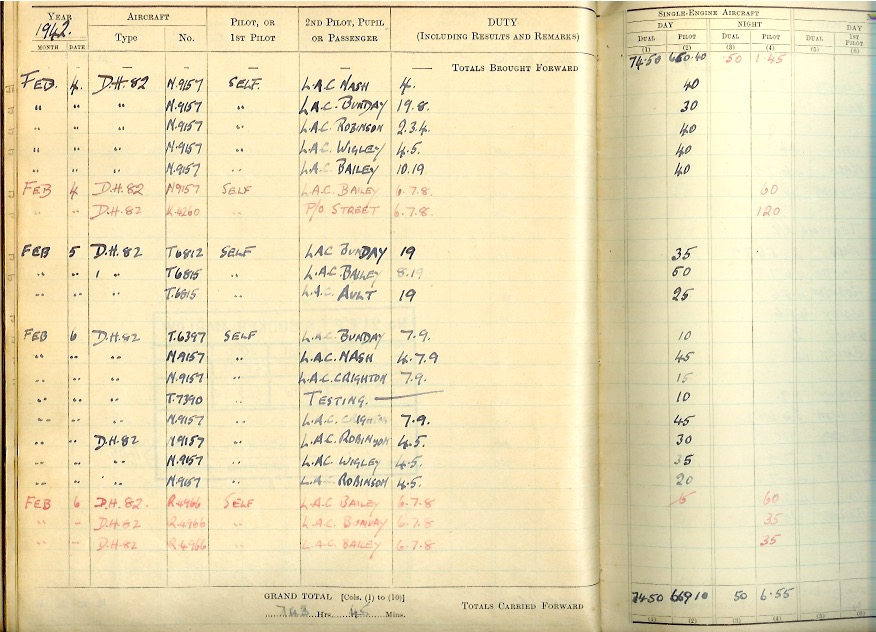
February 1942 found my Grandfather, Howard Kelsey, taking on a very busy training schedule of both day and night training flights on the same date. Indeed, on the 4th Feb., P/O Street had to endure two hours of "circuits and bumps" with my Grandfather, in the open cockpit of a Tiger Moth, on a freezing February night! I just hope he passed this section of his training.
The day flying hours were indicated in the Log book in black ink and the night hours were in red ink. I'm not sure if this sudden increase in night-flying was due to my Grandfather's future ambitions, or due to the fact that the RAF was undertaking far more night operations at this phase of the war, due to the high levels of daylight casualties among RAF crews. Either way, it must have been incredibly uncomfortable and highly dangerous trying to take off and landing in complete darkness.
I have to thank another RAF pilot, Dudley Steynor, who was also a flying trainer for 21 EFTS at the same time as my Grandfather, for writing a blog with his reminiscences of his time at RAF Booker. This blog includes some more great stories and also gives further evidence of the high calibre of person that would be influencing the behaviour of my Grandfather who was still a very young, impressionable man. Dudley Steynor was not only an RAF pilot, but also an accomplished pianist. It seems that many of the RAF trainers had more than one string to their bow. From his blog I learned some more of the daily life of a Pilot trainer at RAF Booker;
"Booker airfield was all grass in those days, and we took off and landed into wind. We commenced flying at 8.00am and flew until 12.30 or 1.00, had some lunch in the mess and returned to our flying at about 2.00pm. At 6.00pm we left the flying to the night boys. Those of us who were flying that night would finish day flying a bit early or might go straight on to night flying and have the following morning off. A busy life but I loved it. There were plenty of challenges to be mastered for we flew in all weathers compatible with the aircraft we flew, Tiger Moths and Magisters. I think most of us became extremely good pilots – as Cecil (Sagittarius Rising) Lewis wrote in his book “All my Yesterdays” ‘There is nothing like instructing for improving one’s flying’."
I also learned from Dudley's blog the rudimentary way that trainee pilots were taught night flying;
"I had many good pupils and rarely failed to get them up to solo flying. I remember one interesting case of a pupil I had to fail on account of his night flying. The glide indicator at the beginning of the approach used three lights – green, amber or red. If you were too high you saw Amber, if you were too low you saw Red and Green was the correct one. The Amber meant closing the throttle to lose some height. The Red meant open the throttle further until you could see Green. This pupil consistently closed the throttle when the red light appeared and I am pretty sure he had no suicide tendencies. He passed all tests for colour blindness. Once when we were three miles away over the valley above Wycombe and the red light showed I had time to ask him ‘What colour do you see?’ He answered ‘Red’. ‘And what does that mean?’ ‘We are too low’ and he opened the throttle a little which I immediately increase to full throttle and hoped I was not too late!"
I'm not sure what he means by "glide indicator", whether this was a light on the instrument panel, or a light shone from the ground. If you know, I would be interested to hear from you.
From my Grandfather's Log book, during a busy January and February 1942, the following pupils were trained by him in Tiger Moths;
LAC Bunday LAC Warnes LAC Walker LAC Bailey
P/O Arnell LAC Osborn LAC Reeve LAC Waters
LAC Thornton LAC Warmsley LAC Dorsie LAC Bubb
LAC Charman LAC Crighton LAC Nash LAC Robinson
LAC Ault LAC Wigley P/O Street F/Lt Riddell
P/O Barlow LAC Gray LAC Geeson LAC Johnston
LAC McCarthy F/O Wheatley P/O Arts.
If you think any of these young men are your relatives, I would be happy to send you a scan of their page from the Log Book.
The war at this time heralded more bad news for Britain with the fall of Singapore to the Japanese resulting in the capture of over 60,000 allied prisoners. We know now how unlikely it was that they would survive the Japanese POW camps. Also the Japanese bombed Darwin, Australia.
Meanwhile the war in Europe was taking a sinister turn when the "Area Bombing Directive" of 14th February 1942 allowed the RAF to start bombing industrial towns and "dehousing" the German population. In other words, bombing women and children. So much for the moral high ground!
Finally, terrible news was filtering through of atrocities being carried out on Russian prisoners of war by the Wehrmacht, following Operation Barbarossa. Of over 3.6 million Soviet Prisoners of War taken in late 1941 to early 1942, nearly all of them were dead. The attempted annihilation of Bolshevism, and ethnic cleansing of "Asiatics" and "Transcaucasians" by order from Nazi high command meant that prisoners were starved, left out in the snow to freeze to death , or simply shot in huge numbers.

Russian POW's 1941