Friday, 8 May 2015

Britain and Russia Together

Here's a question that's going to divide opinion - Who or what saved Britain from losing the Second World War?

No, not Churchill. No, not the Americans. Not the Spitfire, nor the English Channel. It was Stalin and the Russians.

This is not just my opinion but, in 1940's Britain, it was the view of most of the British populace too. During the War, membership of the British Communist Party more than doubled, from 17,756 in September 1939 to 45,435 by March 1945.
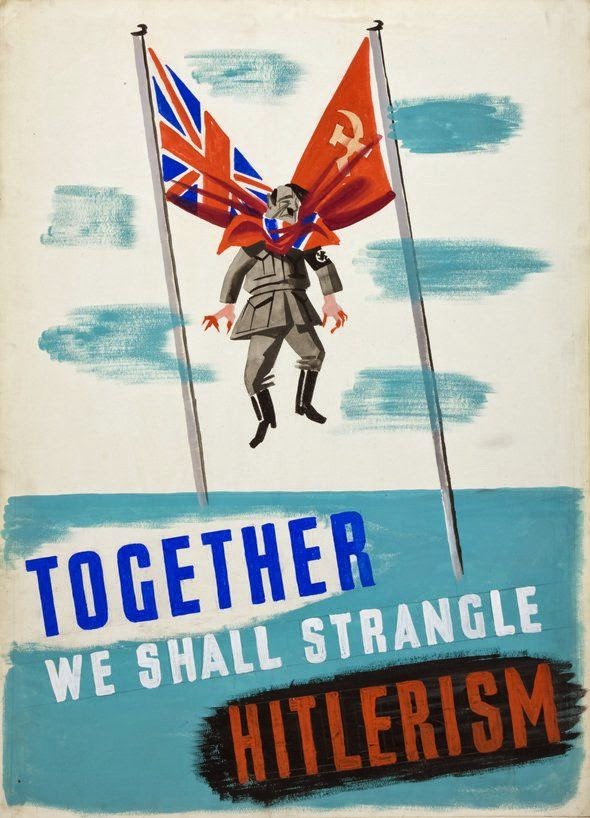

Once Russia had been invaded in Operation Barbarossa, the British government was not slow in using propaganda to encourage the British to embrace their new ally. Stalin, the 'man of Steel' was portrayed as 'Uncle Joe', the cuddly leader who was going to keep us safe in our beds.


There's a nice clip of a wartime film called "Tawny Pipit" which shows the Russians being applauded for helping us in the war. Actually, it's a great film and worth watching in full because it contains lots of "messages" about the way we should behave and the perils of leaving ourselves unguarded from '5th columnists'.


The Internationale - "Tawny Pipit"


The fact that Russia was now on 'our side' would not have gone amiss to my twenty-one year old newly qualified R.A.F. pilot, proudly Socialist, Grandfather, Howard Kelsey. He would have been elated that the political and military left was rising up to confront the Nazis at last. His early attraction to Russia and Communism was to remain with him all his life, despite the Cold War and the atrocities and purges carried out by Stalin that were revealed after the Berlin wall came down. He was learning to write in Russian and had a Russian pen-pal up until the time he lost his eyesight in his eighties. His political views were very important to him, but they did not make for an easy life. Indeed, with the anti-Communist atmosphere and McCarthyism in the late 1950's, his political stance would end his career in the R.A.F. with a great deal of acrimony.

Whatever we think about Stalin, there is no doubt that Russia had to confront the vast majority of the Wehrmacht and the Luftwaffe during the Second World War, and the Russian people lost over 20 million people to the carnage. This fact is terrible enough, but made worse by the news that the Western leaders will snub the 70th V.E. day celebrations in Moscow this year. Guardian link to Moscow Snub We never learn!

Sunday, 3 May 2015

Doug Gregory DFC R.I.P.

Sad news today to read that Doug Gregory DFC has died. He was knocked down by a car whilst walking to collect his newspaper and died in hospital two weeks later. Here is the Telegraph obituary;

Doug Gregory - Pilot obituary


 Doug Gregory DFC

Doug Gregory served as a pilot during World War 2 on 141 Squadron at the same time as my Grandfather, Howard Kelsey. He later wrote a book called Aeroaddict (here's a link) which I am using to fill in some of the colour and flavour of their time on the squadron. My Grandfather was very tight-lipped about his wartime experience, so I am having to use other sources to try and find out more about what RAF life was like back then.

Here's a clip of Doug talking about flying Beaufighters; Doug Gregory and the Bristol Beaufighter

As a mark of respect I thought I would post a scan of one of Doug Gregory's combat reports. By this time he was flying DeHavilland Mosquitoes. One night in July 1944, along with his navigator Steve Stephens, he shot down a JU88 over Beauvais, France.


On August 5th that year he was awarded the DFC. It is typical of Doug that the comment beside the log-book entry mentioning the award of his DFC reads “I still don't know why”.

So another night fighter pilot is added to the 'celestial score' but I hope his memory will live on.


Sunday, 19 April 2015

Flying Instructor Training


On 23rd May 1941 my Grandfather bid farewell to P/O Stearn and 22 E.F.T.S and moved on to train as a Flying Instructor at 4 S.F.I.S ((Supplementary) Flying Instructors School) at R.A.F. Cambridge. 

The Log Book shows that on 26th May, he had a flight in a Miles Magister L.8176 under the instruction of P/O Tompkins. This is the first new aircraft type my Grandfather flew in. Miles Magister - Flight tests

Affectionately known as the "Maggie" this open cockpit monoplane had a much better viewing position for the pilot plus the introduction of flaps, brakes and a tail wheel for the trainee pilot to contend with. It also had it's own flying idiosyncrasies, too much pressure on the rudder bar and the aircraft would pitch abruptly earthwards!


Here's a clip of a "Maggie" in flight

For the remainder of May and June 1941 my Grandfather went through a rigorous set of flying tests to assess his abilities.


Finally, on the 25th June 1941, following the "C.O's Test" with S/Ldr A.D. Bennett he qualified as an Elementary Flying Instructor.


At the same time, Operation Barbarossa, the invasion of Russia by the German forces, had commenced. This was the largest military operation in World history, and would be both the salvation of the Western allies and the ultimate downfall of Hitler and the Nazis.


Monday, 6 April 2015

Sequence of Instruction


Throughout April and into May 1941, my Grandfather continued training in D.H. 82 Tiger Moths, with endless circuits and 'bumps' (landing and take off), as well as a bewildering series of numbered activities. By now, these numbers were so mundane that my Grandfather no longer bothered to fill in what the numbers referred to in the "Duty" column. So following some investigation, I have found out the following 'Sequence of Instruction';

1. Air experience 
1A. Familiarity with cockpit layout 
2. Effect of controls 
3. Taxying 
4. Straight and level flying 
5. Climbing, gliding and stalling (includes stall off steep turn. High speed stall) 
6. Medium turns 
7. Taking off into wind 
8. Powered approach and landing 
9. Gliding approach and landing 
10. Spinning (with instructor only) 
11. First solo 
12. Sideslipping 
13. Precautionary landing 
14. Low flying (with instructor only) 
15. Steep turns 
16. Climbing turns 
17. Forced landings 
18. Action in event of fire (with instructor only) (including abandoning an aircraft to be given on the ground) 
19. Instrument flying 
20. Taking off and landing out of wind 
21. Aerobatics 
22. Air navigation 
23. Air navigation test 
24. Night flying (record number of landings) 
25. Formation flying

I guess that the more often repeated activities were the ones that had not quite been mastered satisfactorily. 

One of the strangest things to happen in the War occurred in May 1941. While the Luftwaffe was making one last effort to bomb London into submission, a lone Me 110 was flying to Scotland. The pilot baled out and upon being apprehended, announced himself as Rudolf Hess, Hitler's deputy in the Nazi Party. There is more about this on the World War 2 Today Website .


Saturday, 28 March 2015

Proficiency as Pilot - Average


After a further 20 hours flying training, which included aerobatics, climbing turns, spinning, sideslipping, forced landings, x. country flights, both solo and under instruction, as well as 6 hours 30 minutes instrument flying, L.A.C. Kelsey passed his Elementary flying training on 18/4/1941. He was graded as "Average".

Now came the time for him to be assessed for the next posting in his R.A.F. career. In order to help work out where best to utilise this fledgling pilot, my Grandfather was posted to 22 E.F.T.S Cambridge.


R.A.F. Cambridge was located on the eastern outskirts of the historic University City, next to the village of Teversham. It was approximately 40 miles east of Sywell, and also utilised a large expanse of grass as a landing strip. The training at 22 E.F.T.S. was still in D.H.82 dual control Tiger Moths. These grass landing strips were often the nice soft saviour of many a bumpy landing!


The trainee pilots were billeted in Nissen huts on the northern edge of the airfield, which may explain my Grandfather's love affair with these structures! After retirement, in the 1980's, he spent many laborious hours in his garden in Norfolk turning one of these Nissen huts into a Nuclear Bomb shelter for himself and his nearest and dearest. The wartime billets were heated by one cast iron boiler in the centre and renowned for being freezing in the winter and boiling in the summer. 

After his 47 hours in the air, I wonder if he was a bit put-out to only get a grading of average. If so, he needn't have worried as almost all the other pilots I have read about achieved the same grade.

The news of the war in April 1941 was going from bad to worse for the allies. German forces invaded both Greece and Yugoslavia simultaneously. Yugoslavia capitulated on the 18th April and on 27th German forces entered Athens. 

Thursday, 12 March 2015

'Link' Trainer


For trainee pilots, as well as classroom theory and time in the air, there would be time spent in a machine called a Link Trainer. Designed in the USA in the 1920's by Edwin A. Link, this contraption allowed rudimentary piloting skills to be learned without fear of serious injury. As an introduction to night flying, all took blind-flying instruction in the Link. Movement of the trainer is accomplished by vacuum operated bellows, controlled by valves connected to the control wheel (or stick) and rudder pedals. An instructor sat at the desk and transmitted radio messages which the student in the Link heard through his earphones. Inside the "cockpit", the student relied on his instruments to "fly" the Link through various manoeuvers while his navigational "course" was traced on a map on the desk by the three-wheeled "crab". Slip stream simulators gave the controls the feeling of air passing over control surfaces, and a rough air generator added additional realism during the "flight". 

The 'Link' was the first true flight simulator, and provided safe training to hundreds of thousands of student pilots during the 1930s and 40s.

There were a series of standard exercises to be mastered on the link trainer and it was often housed in it's own purpose built building at many RAF stations.


My Grandfather spent 8 hours and 5 minutes training in the Link and passed with an assessment of 'Average'. I expect he was very pleased to see the back of it! 


Wednesday, 4 March 2015

First Solo


So the big moment dawned. This was going to be the test to see if H.C.Kelsey could cut it in the R.A.F. There were usually eighty trainees on the course but only forty would go forward. You were expected to go solo on the Tiger Moth at around 8 hours, certainly not more than 10. Otherwise you would be "scrubbed" and posted to a navigator's course or air gunner or bomb aimer and the likes. One after another, men would come in joyously saying they had gone solo and then there were those with long faces that said one word "scrubbed" and then were gone the next day. 

From his Log Book, it looks as though my Grandfather had hit it right on time at 8hrs 10 minutes for his first 'Solo'. He was taken up for his 'Solo Test' by Sgt. Pawson on 14th March and perhaps Sgt Pawson recommended a bit more practise on 'Gliding Approach and Landing'? Then on 15th March 1941 he was up there alone for the first time, what a feeling that must have been! I can just imagine his beaming face when he landed and ran off to boast to his mates that he had done it..."Gone Solo".


Meanwhile, the War was hitting Scotland, as the 14/15th March saw the "Clydeside Blitz".